



About the Journal
Focus, Aim, Scopes
Journal of Artificial Intelligence in Architecture (JARINA) is currently accepting research article and systematic review manuscript. Journal of Artificial Intelligence in Architecture (JARINA) discusses the role of digital art, science, and technology in architecture in an informative and accessible way. JARINA focuses on combining architecture, informatics, and neuroscience. Topics covered by JARINA including:
- History of artificial intelligence in architecture
- Philosophy of artificial intelligence in architecture
- Hardware and software supporting artificial intelligence in architecture (big data, laser 3D scanner, etc.)
- Digital technology in architecture education
- Best practices of digital application in architectural works
- Presentation techniques (animation, holograph, etc.)
- Modeling (parametric, building information modeling, hypersurface, etc.)
- Simulation (lighting, acoustics, ventilation, structure, tsunami, earthquake, fire, urban heat island, etc.)
- Digital fabrication
- Human activities (public movement, body movement, etc.)
- Gameworld (virtual architecture, avatar, cyberspace, etc.)
- Intelligent architecture (smart building, building automation, etc.)
- Mixed reality (hyper-reality, augmented virtual reality, etc.)
- Artificial intelligence (machine learning, deep learning, neuro-computer interface, etc.)
- Digital architect (intelligent architect, design automation, architect-less architecture design, etc.)
- Neuro-architecture
- Metaverse
JARINA is a valuable resource for professionals, teachers, researchers, and students in various backgrounds, including the following disciplines:
- Architecture
- Urban design
- Building Sciences
- Informatics Engineering in Architecture
- Neuro-Psychology in Architecture
Published papers will report on fundamental research and applied research. Thus, readers benefit from exploring the interaction between theories and practices.
To ensure the integrity of the published papers, independent, anonymous experts will double-blind peer review all the submitted manuscripts after the Editor's initial appraisal.
The Journal of Artificial Intelligence in Architecture (JARINA) is pleased to announce its successful accreditation by ARJUNA. JARINA has been granted SINTA 4 (S4) from Volume 1 No 1, 2022 until Volume 5 No 2, 2026 , effective October 15th, 2024.
JARINA publishes twice a year in February and August
Peer Review Process
The submitted manuscript will be evaluated first by the editor, whether it is suitable for JARINA: Journal of Artificial Intelligence in Architecture focus and scope or has a major methodological flaw and checking similarity score using Turnitin. The manuscript will be sent to at least two anonymous reviewers with the Double-Blind Review system. Reviewers' comments are then sent to the corresponding author for necessary actions and responses. The suggested decision will be evaluated in an editorial board meeting. Afterward, the editor will send the final decision to the corresponding author.
Manuscript Process Workflow and Guidelines
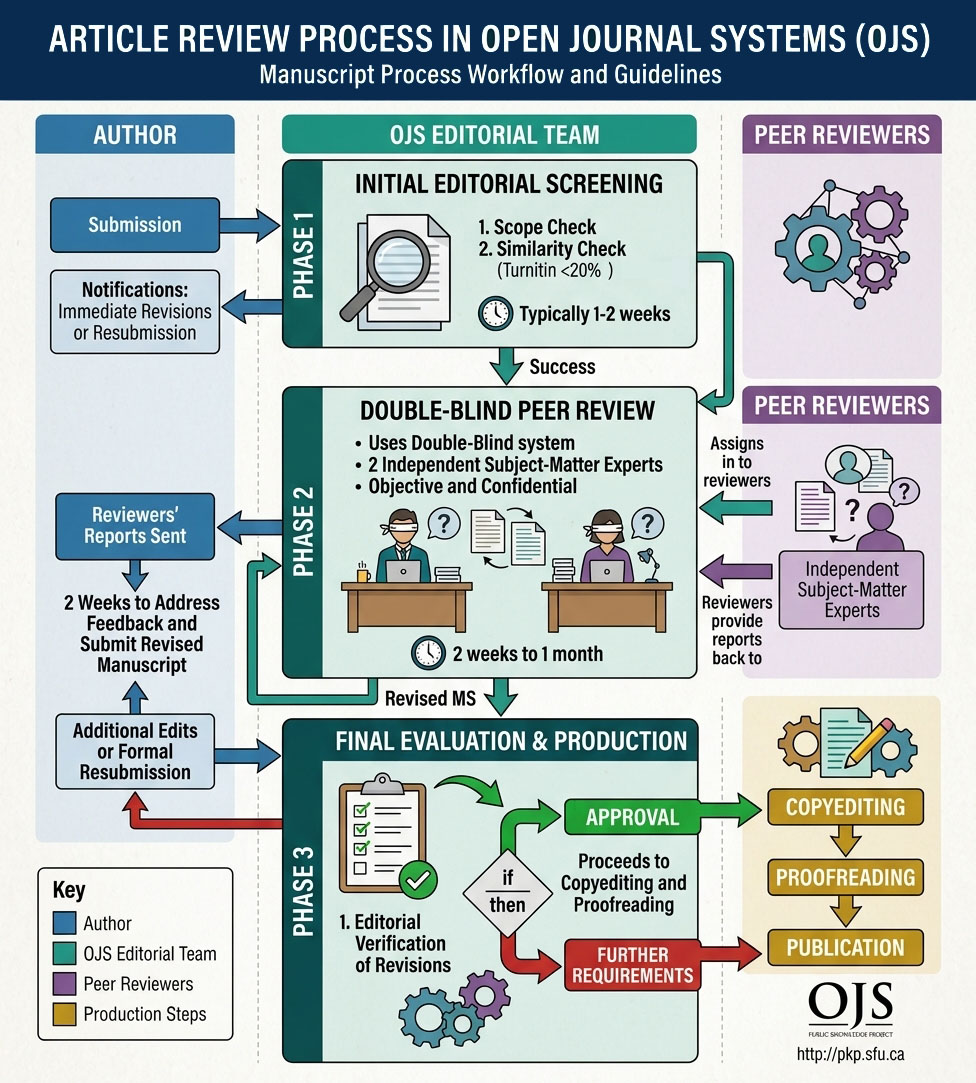
Phase 1: Initial Editorial Screening Upon submission, your manuscript undergoes a preliminary evaluation to ensure it aligns with the journal's scope and meets our originality standards. We utilize Turnitin to conduct a similarity check; while the maximum allowable similarity index is 20%, we strongly encourage authors to aim for a score below 15%. This stage typically concludes within one up to two week, after which we will notify you if any immediate revisions or a resubmission are required.
Phase 2: Double-Blind Peer Review Manuscripts that successfully pass the initial screening are advanced to the formal review stage. This process employs a double-blind peer review system involving two independent subject-matter experts to ensure the utmost objectivity and confidentiality for both parties. The review duration generally spans from two weeks to one month. Following the receipt of the reviewers' reports, you will be granted two weeks to address the feedback and submit your revised manuscript.
Phase 3: Final Evaluation and Production Once your revised article is submitted, the Editorial Team will verify that all reviewer comments have been addressed comprehensively.
-
Approval: If the revisions meet the required standards, the manuscript will proceed to the copyediting and proofreading phase in preparation for publication.
-
Further Requirements: Should the revisions remain incomplete or require significant further work, we may request additional edits or a formal resubmission.
Policy Regarding the Letter of Acceptance (LoA) Please be formally advised that a Letter of Acceptance (LoA) is issued exclusively upon the successful completion of the peer-review process, the fulfillment of all requested revisions, and a final decision of 'Accepted' by the Editor-in-Chief. An LoA cannot be provided while the manuscript is still under evaluation.
Archiving
This journal utilizes the LOCKSS system to create a distributed archiving system among participating libraries and permits those libraries to create permanent archives of the journal for purposes of preservation and restoration. More...
Open Access Policy
This journal provides immediate open access to its content on the principle that making research freely available to the public supports a greater global exchange of knowledge.
Screening for Plagiarism Policy
JARINA: Journal of Artificial Intelligence in Architecture has a policy of screening for plagiarism. We use the Anti-Plagiarism Software "Turnitin" to check the authenticity of the article.
License
This work is licensed under a Creative Commons Attribution 4.0 International License.
Publication Ethics
Duties of Authors
- Reporting Standards:
Authors of reports of original research should present an accurate account of the work performed as well as an objective discussion of its significance. Underlying data should be represented accurately in the paper. A paper should contain sufficient detail and references to permit others to replicate the work. Fraudulent or knowingly inaccurate statements constitute unethical behaviour and are unacceptable. - Data Access and Retention:
Authors are asked to provide the raw data in connection with a paper for editorial review, and should be prepared to provide public access to such data (consistent with the ALPSP-STM Statement on Data and Databases), if practicable, and should in any event be prepared to retain such data for a reasonable time after publication. - Originality and Plagiarism: The authors should ensure that they have written entirely original works, and if the authors have used the work and/or words of others that this has been appropriately cited or quoted. The manuscript should not be submitted concurrently to more than one publication unless the editors have agreed to co-publication. Relevant previous work and publications, both by other researchers and the authors’ own, should be properly acknowledged and referenced. The primary literature should be cited where possible. Original wording taken directly from publications by other researchers should appear in quotation marks with the appropriate citations. Similiarity score should be under 15% (such as using tools like Turnitin)
- Multiple, Redundant or Concurrent Publication:
An author should not, in general, publish manuscripts describing essentially the same research in more than one journal or primary publication. Submitting the same manuscript to more than one journal concurrently constitutes unethical publishing behavior and is unacceptable. - Acknowledgment of Sources:
Proper acknowledgment of the work of others must always be given. Authors should cite publications that have been influential in determining the nature of the reported work. - Authorship of the Paper:
Authorship should be limited to those who have made a significant contribution to the conception, design, execution, or interpretation of the reported study. All those who have made significant contributions should be listed as co-authors. Where there are others who have participated in certain substantive aspects of the research project, they should be acknowledged or listed as contributors. The corresponding author should ensure that all appropriate co-authors and no inappropriate co-authors are included on the paper and that all co-authors have seen and approved the final version of the paper and have agreed to its submission for publication. - Disclosure and Conflicts of Interest:
All authors should disclose in their manuscript any financial or another substantive conflict of interest that might be construed to influence the results or interpretation of their manuscript. All sources of financial support for the project should be disclosed. Authors must disclose the use of AI tools in a "Declaration of the Use of AI" or "Acknowledgements" section. This disclosure should include the tool's name, version, and purpose.AI usage is recommended to be below 50%. - Fundamental errors in published works:
When an author discovers a significant error or inaccuracy in his/her own published work, it is the author’s obligation to promptly notify the journal editor or publisher and cooperate with the editor to retract or correct the paper. - Hazards and Human or Animal Subjects:
If the work involves chemicals, procedures or equipment that have any unusual hazards inherent in their use, the author must clearly identify these in the manuscript. - Copyright :
Copyright by author(s). Authors who publish with this journal agree to the following terms:
- Authors retain copyright and grant the journal right of first publication with the work simultaneously licensed under a Creative Commonsthat allows others to share the work with an acknowledgement of the work's authorship and initial publication in this journal.
- Authors are able to enter into separate, additional contractual arrangements for the non-exclusive distribution of the journal's published version of the work (e.g., post it to an institutional repository or publish it in a book), with an acknowledgement of its initial publication in this journal.
- Authors are permitted and encouraged to post their work online (e.g., in institutional repositories or on their website) prior to and during the submission process, as it can lead to productive exchanges, as well as earlier and greater citation of published work (See The Effect of Open Access).
Duties of Editors
- Fair Play:
An editor at any time evaluates manuscripts for their intellectual content without regard to race, gender, sexual orientation, religious belief, ethnic origin, citizenship, or political philosophy of the authors. - Confidentiality:
The editor and any editorial staff must not disclose any information about a submitted manuscript to anyone other than the corresponding author, reviewers, potential reviewers, other editorial advisers, and the publisher, as appropriate. - Disclosure and Conflicts of Interest:
Unpublished materials disclosed in a submitted manuscript must not be used in an editor's own research without the express written consent of the author. - Publication Decisions:
The editor board journal is responsible for deciding which of the articles submitted to the journal should be published. The validation of the work in question and its importance to researchers and readers must always drive such decisions. The editors may be guided by the policies of the journal's editorial board and constrained by such legal requirements as shall then be in force regarding libel, copyright infringement and plagiarism. The editors may confer with other editors or reviewers in making this decision. - Review of Manuscripts:
The editor must ensure that each manuscript is initially evaluated by the editor for originality. The editor should organise and use peer review fairly and wisely. Editors should explain their peer review processes in the information for authors and also indicate which parts of the journal are peer reviewed. The editor should use appropriate peer reviewers for papers that are considered for publication by selecting people with sufficient expertise and avoiding those with conflicts of interest.
Duties of Reviewers
- Contribution to Editorial Decisions:
Peer review assists the editor in making editorial decisions and through the editorial communications with the author may also assist the author in improving the paper. - Promptness:
Any selected referee who feels unqualified to review the research reported in a manuscript or knows that its prompt review will be impossible should notify the editor and excuse himself from the review process - Standards of Objectivity:
Reviews should be conducted objectively. Personal criticism of the author is inappropriate. Referees should express their views clearly with supporting arguments. - Confidentiality:
Any manuscripts received for review must be treated as confidential documents. They must not be shown to or discussed with others except as authorized by the editor. - Disclosure and Conflict of Interest:
Privileged information or ideas obtained through peer review must be kept confidential and not used for personal advantage. Reviewers should not consider manuscripts in which they have conflicts of interest resulting from competitive, collaborative, or other relationships or connections with any of the authors, companies, or institutions connected to the papers.
Acknowledgement of Sources
Reviewers should identify relevant published work that has not been cited by the authors. Any statement that an observation, derivation, or argument had been previously reported should be accompanied by the relevant citation. A reviewer should also call to the editor's attention any substantial similarity or overlap between the manuscript under consideration and any other published paper of which they have personal knowledge
Article Processing Charge (APC)
Author(s) Fee
This journal charges the following author fees. (Free of APC)
Article Submission: 0.00 (IDR)
Article Publication: 0.00 (IDR)