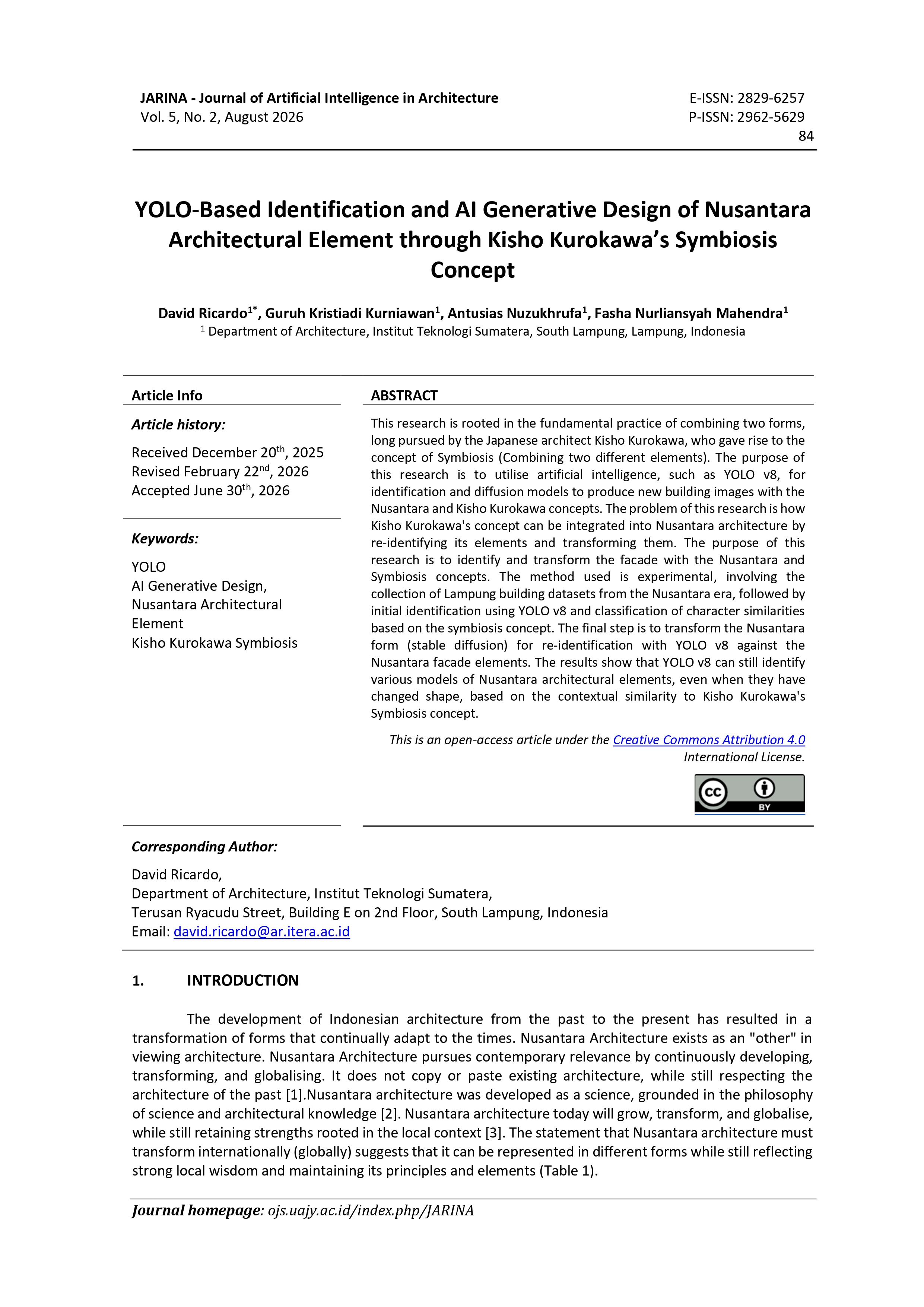
YOLO-Based Identification and AI Generative Design of Nusantara Architectural Element through Kisho Kurokawa’s Symbiosis Concept
DOI:
https://doi.org/10.24002/jarina.v5i2.13626Keywords:
YOLO, AI Generative Design, Nusantara Architectural, Element, Kisho Kurokawa SymbiosisAbstract
This research is rooted in the fundamental practice of combining two forms, long pursued by the Japanese architect Kisho Kurokawa, who gave rise to the concept of Symbiosis (Combining two different elements). The purpose of this research is to utilise artificial intelligence, such as YOLO v8, for identification and diffusion models to produce new building images with the Nusantara and Kisho Kurokawa concepts. The problem of this research is how Kisho Kurokawa's concept can be integrated into Nusantara architecture by re-identifying its elements and transforming them. The purpose of this research is to identify and transform the facade with the Nusantara and Symbiosis concepts. The method used is experimental, involving the collection of Lampung building datasets from the Nusantara era, followed by initial identification using YOLO v8 and classification of character similarities based on the symbiosis concept. The final step is to transform the Nusantara form (stable diffusion) for re-identification with YOLO v8 against the Nusantara facade elements. The results show that YOLO v8 can still identify various models of Nusantara architectural elements, even when they have changed shape, based on the contextual similarity to Kisho Kurokawa's Symbiosis concept.
References
[1] A. A. Darsono and J. Prijotomo, "INDONESIAN AIRPORT DESIGN STUDY: NUSANTARA IDENTIFIED BY SPATIAL FORM, SHAPE, AND ORNAMENTATION," vol. 09, pp. 1-20, 2024.
[2] J. O. Waani and J. Rengkung, "Tipe teori pada arsitektur nusantara menurut josef prijotomo," vol. 11, no. 2, pp. 32-47, 2014.
[3] D. N. Alia and Y. Saliya, "THE REFLECTION OF NUSANTARA ARCHITECTURE IN THE CENTRAL ADMINISTRATION BUILDING APPEARANCE, GEDUNG PUSAT ADMINISTRASI UNIVERSITAS," vol. 06, pp. 440-451, 2022. https://doi.org/10.26593/risa.v6i04.6152.440-451
[4] E. N. Histanto, "Tinjauan Prinsip dan Elemen Disain di Arsitektur Nusantara Studi Kasus Arsitektur Batak Toba," vol. 1, no. 2, pp. 105-116, 2023, https://doi.org/10.59810/archimane.v1i2.12
[5] U. Joko, B. Setioko, and T. Woro, "TRANSFORMATION OF FORM IN THE GROWTH OF MODERN JAVANESE HOUSE IN LAWEYAN SURAKARTA," vol. 41, no. 4, pp. 288-295, 2017. https://doi.org/10.3846/20297955.2017.1411848
[6] J. Adiyanto, "ARSITEKTUR SEBAGAI MANIFESTASI IDENTITAS INDONESIA Keywords : architectural history , Indonesia , identity politics , semiotic , synchronic-diachronic," pp. 139-150, 2021. https://doi.org/10.24853/nalars.21.2.139-150
[7] S. Lampung, D. Pekon, and H. Lampung, "Kajian arsitektur vernakular (ruang dan struktur) lampung. desa pekon hujung lampung barat," vol. 22, no. 1, pp. 15-24, 2021. https://doi.org/10.26905/jam.v1i1.4626
[8] G. D. E. Bagus, A. Wicaksana, I. D. A. Bagus, and G. Parama, "IMPLEMENTASI PENGGUNA ARTIFICIAL INTELEGENT ( AI ) PADA PLATFORM MIDJOURNEY DALAM ITERASI ARSITEKTUR," pp. 1212-1221, 2023. https://doi.org/10.35327/gara.v17i3.565
[9] V. Rauf, V. E. L. İbey, and F. Sedes, "Preserving Cultural Heritage and Shaping Sustainable Urban Futures : The Transformative Impact of Symbiotic Architecture On Historical Buildings," vol. 2024, pp. 147-163, 2024, doi: 10.17932/IAU.ARCH.2015.017/arch.
[10] Kisho Kurokawa, The Philosophy of Symbiosis.
[11] A. D. Nugroho and W. M. Baihaqi, "Improved YOLOv5 with Backbone Replacement to MobileNet V3s for School Attribute Detection," vol. 8, no. 3, pp. 1944-1954, 2023. https://doi.org/10.33395/sinkron.v8i3.12702
[12] A. A. Permana, M. R. Muttaqin, and M. A. Sunandar, "SISTEM DETEKSI API SECARA REAL TIME MENGGUNAKAN ALGORITMA YOU ONLY LOOK ONCE ( YOLO ) VERSI 8," vol. 8, no. 5, pp. 10395-10400, 2024. https://doi.org/10.36040/jati.v8i5.10847
[13] S. Jamal and H. Wimmer, "Perception and evaluation of text-to-image generative AI models: a comparative study of DALL-E, Google Imagen, GROK, and Stable Diffusion," vol. 25, no. 2, pp. 277-292, 2024.
[14] N. Dehouche and K. Dehouche, "Jo ur n re of," HELIYON, p. e16757, 2023, https://doi.org/10.1016/j.heliyon.2023.e16757
[15] P. A. Nusantara, Y. Pratomo, and Y. P. Prihatmaji, "Periodisasi Arsitektur Nusantara e-ISSN 2774-5155 p-ISSN 2774-5147," vol. 4, no. 9, pp. 712-720, 2024. https://doi.org/10.59188/jurnalsostech.v4i9.1364
[16] M. A. Widagdo, Y. Kusumarini, P. Studi, D. Interior, U. K. Petra, and J. Siwalankerto, "Studi Terapan Konsep Metabolisme dan Simbiosis pada Bangunan Karya Kisho Kurokawa," vol. 1, no. 2, pp. 1-11, 2013.
[17] W. Abdillah, M. N. Loebis, and D. N. Aulia, "Perwujudan Filosofi Buddha Pada Karya Arsitektur Kisho Kurokawa," vol. 2, no. 2, pp. 66-92, 2018.
[18] K. Kurokawa and K. Arsitektur, "WAHYU ABDILLAH 127020012 / AR FAKULTAS TEKNIK," 2018.
[19] H. Jo, J. K. Lee, Y. C. Lee, and S. Choo, "Generative artificial intelligence and building design: early photorealistic render visualization of façades using local identity-trained models," J. Comput. Des. Eng., vol. 11, no. 2, pp. 85-105, 2024, https://doi.org/10.1093/jcde/qwae017
[20] S. Xu, J. Zhang, and Y. Li, "Knowledge-Driven and Diffusion Model-Based Methods for Generating Historical Building Facades: A Case Study of Traditional Minnan Residences in China," Inf., vol. 15, no. 6, 2024, https://doi.org/10.3390/info15060344
[21] K. Her and F. Arts, "Nakagin Capsule Tower : In Pieces Faculty Advisor : Amanda Horton , MFA," vol. 1960, no. May 1960, pp. 672-675, 2020.
Downloads
Published
How to Cite
Issue
Section
Categories
License
Copyright (c) 2026 David Ricardo, David Ricardo, Guruh Kristiadi Kurniawan, Antusias Nuzukhrufa, Fasha Nurliansyah Mahendra

This work is licensed under a Creative Commons Attribution 4.0 International License.
Authors who publish with this journal agree to the following terms:
1.Authors retain copyright and grant the journal right of first publication with the work simultaneously licensed under a Commons Attribution 4.0 International License that allows others to share the work with an acknowledgement of the work's authorship and initial publication in this journal.
2.Authors are able to enter into separate, additional contractual arrangements for the non-exclusive distribution of the journal's published version of the work (e.g., post it to an institutional repository or publish it in a book), with an acknowledgement of its initial publication in this journal.
3.Authors are permitted and encouraged to post their work online (e.g., in institutional repositories or on their website) prior to and during the submission process, as it can lead to productive exchanges, as well as earlier and greater citation of published work (See The Effect of Open Access).