 Abstract views: 113 times |
  Downloads: 97 times |
 DOI:
DOI:


Vol. 5 No. 2 (2026): Artificial Intelligence for Architecture: From Sustainable Management to Digital Heritage and Design Innovation
Architecture is increasingly influenced by the development of artificial intelligence (AI) and digital technologies. These technologies are expanding beyond design visualisation to support sustainable resource management, cultural heritage documentation, environmental assessment, and architectural design exploration. This development creates new opportunities to connect technological innovation with cultural, environmental, and contextual considerations in architecture.
In this issue of JARINA (Journal of Artificial Intelligence in Architecture) Volume 5, No. 2 (2026), we present five scholarly contributions exploring different applications of digital technology and AI in architecture.
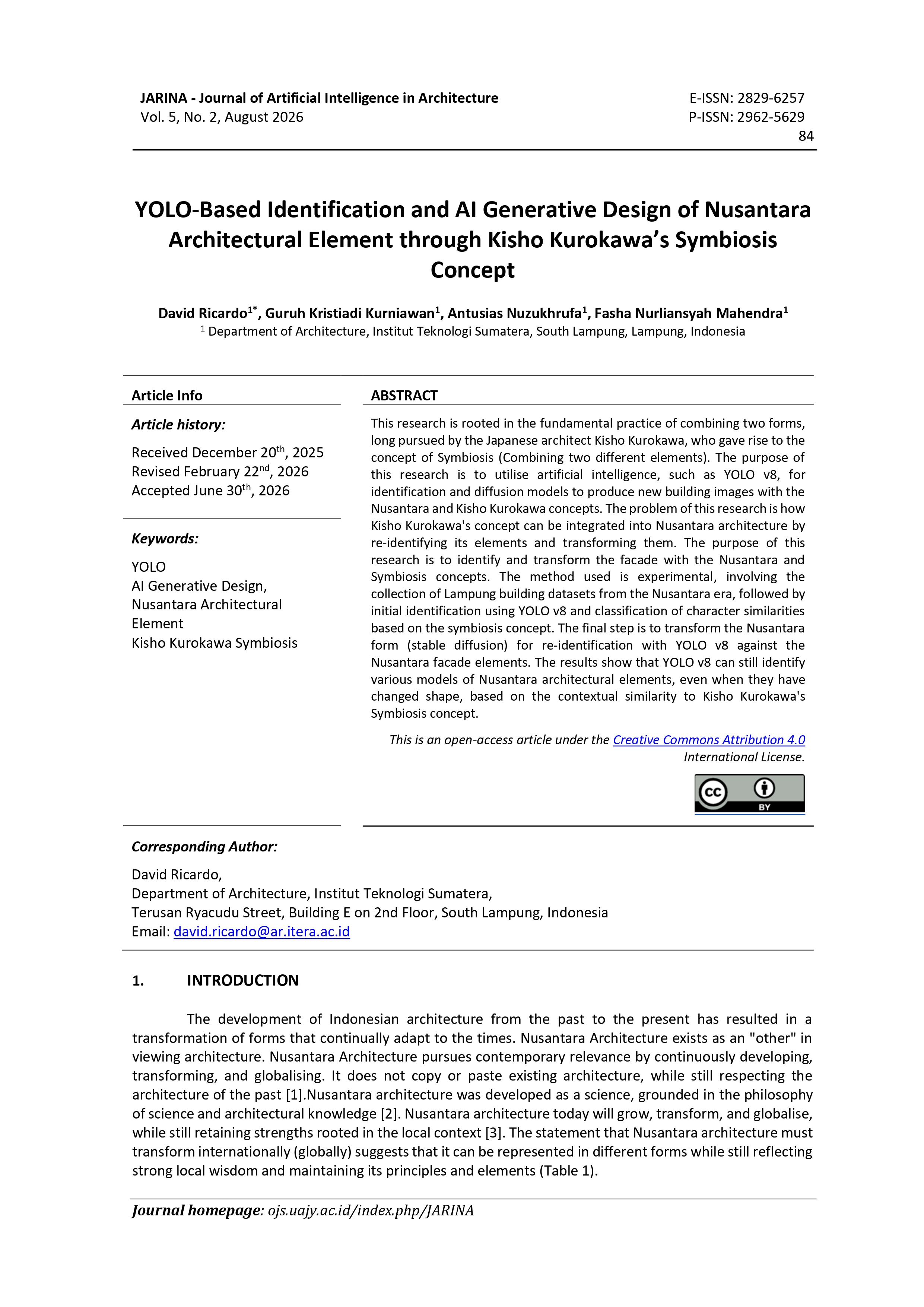
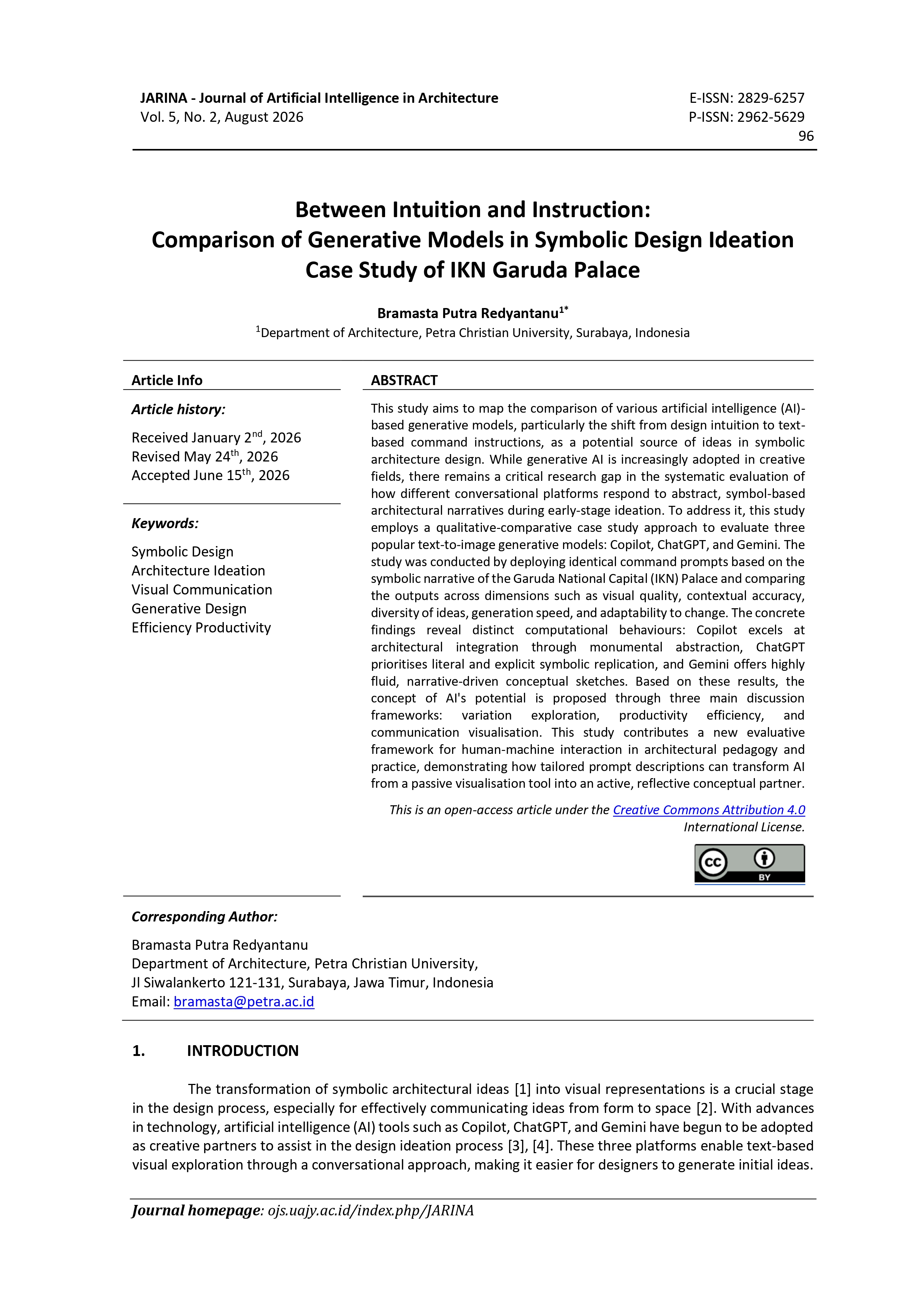
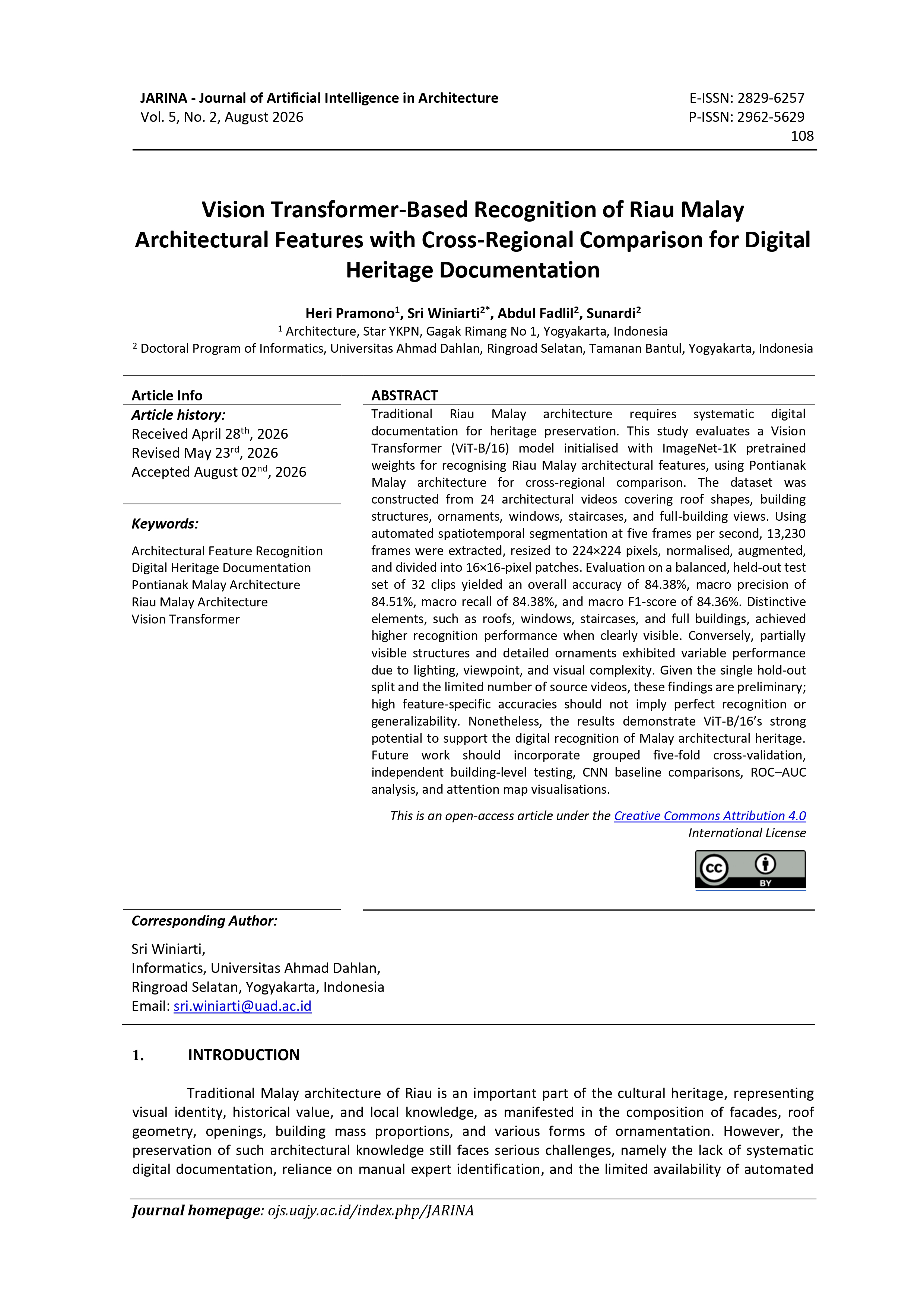
The issue “Artificial Intelligence for Architecture: From Sustainable Management to Digital Heritage and Design Innovation” opens with a study on digital technologies for sustainable natural resource management in Indonesia, highlighting the role of IoT, BIM, GIS, and other digital tools in supporting monitoring, planning, and sustainable policy development. This is followed by research applying Vision Transformer technology to recognise Riau Malay architectural features, demonstrating the potential of AI-based computer vision for digital heritage documentation. The third study examines outdoor thermal comfort in an urban park by integrating field-based microclimate measurements with solar path simulation. The research demonstrates how environmental analytics can support climate-responsive landscape design. The fourth contribution explores the use of YOLO v8 and generative AI to identify and transform Nusantara architectural elements through Kisho Kurokawa’s concept of Symbiosis, offering new possibilities for combining cultural references with contemporary design exploration.
The issue concludes with a comparative study of generative AI models for ideation in symbolic architectural design, using the Garuda Palace in IKN as a case study. The research compares the outputs of Copilot, ChatGPT, and Gemini and discusses their potential to support variation, productivity, and communication in early-stage architectural design.
Collectively, these studies demonstrate the growing potential of AI and digital technologies to support architecture across sustainability, heritage, environmental performance, and design innovation. Rather than replacing architectural knowledge and judgment, technology can function as an extension of human capabilities, enabling architects and researchers to analyse, recognise, explore, and develop architectural solutions more effectively.
We extend our sincere appreciation to the authors, reviewers, and editorial team for their contributions that made this issue possible. We hope that JARINA Volume 5, No. 2 (2026) will encourage further interdisciplinary research and dialogue on the responsible and innovative application of AI and digital technologies in architecture.
Khaerunnisa
EDITOR IN CHIEF
J A R I N A
Journal of Artificial Intelligence in Architecture
Published:
2026-08-18