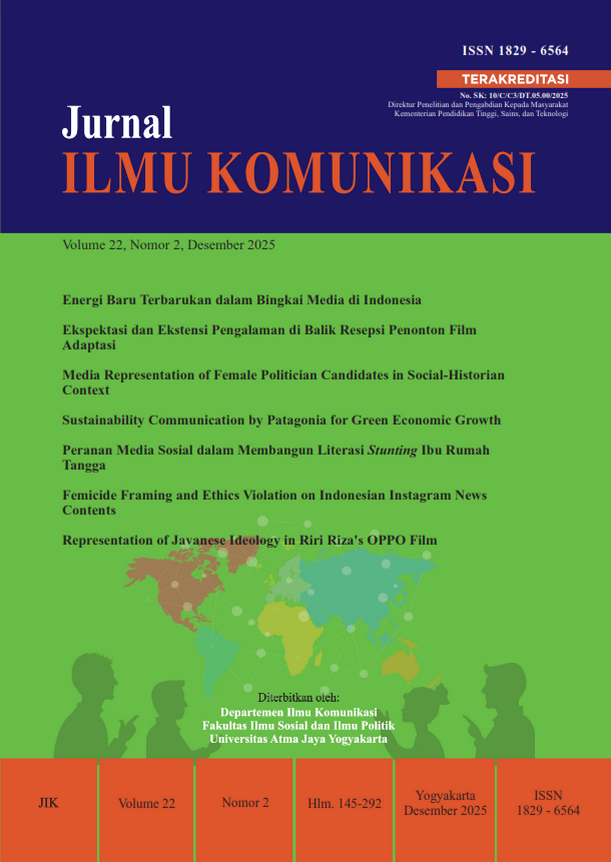
Peranan Media Sosial dalam Membangun Literasi Stunting Ibu Rumah Tangga
DOI:
https://doi.org/10.24002/jik.v22i2.10164Abstract
Stunting merupakan permasalahan multisektor dengan dampak jangka panjang hingga usia dewasa, serta berpotensi diturunkan ke generasi berikutnya. Penanggulangan stunting dilakukan melalui intervensi spesifik dan intervensi sensitif. Penelitian ini bertujuan menganalisis peran media sosial yang banyak dimanfaatkan sebagai sarana intervensi sensitif dalam meningkatkan literasi stunting. Data dikumpulkan melalui kuesioner dengan teknik stratified random sampling dan dianalisis menggunakan analisis jalur dengan SPSS AMOS. Hasil penelitian menunjukkan media sosial berpengaruh tidak langsung terhadap literasi stunting pada ibu rumah tangga melalui variabel pengetahuan. Fenomena banjir informasi di media sosial mungkin menyebabkan tidak ditemukannya pengaruh langsung media sosial terhadap literasi stuntingReferences
Ajzen, I. (2005). Attitudes, personality, and behavior (2nd ed). Berkshire, England: Open University Press.
Annur, C. M. (2023, Juni 19). DI Yogyakarta raih indeks literasi digital tertinggi nasional pada 2022. Katadata.co.id. <https://databoks.katadata.co.id/teknologi-telekomunikasi/statistik/5a3963423228f2a/di-yogyakarta-raih-indeks-literasi-digital-tertinggi-nasional-pada-2022>
APJII. (2023). Profil internet Indonesia. <https://survei.apjii.or.id/>
Athey, S., Grabarz, K., Luca, M., & Wernerfelt, N. (2023). Digital public health interventions at scale: The impact of social media advertising on beliefs and outcomes related to COVID vaccines. Proceedings of the National Academy of Science of the United States of America, 120 (5), e2208110120, 1-8. https://doi.org/10.1073/pnas.2208110120.
Azriani, D., Masita., Qinthara, N. S., Yulita, I. N., Agustian, D., Zuhairini, Y., & Dhamayanti, M. (2024). Risk factors associated with stunting incidence in under five children in Southeast Asia: A scoping review. Journal of Health Population and Nutrion, 43, 174, 1-13. https://doi.org/10.1186/s41043-024-00656-7
Badan Pengembangan dan Pembinaan Bahasa. (2023). Kamus besar bahasa Indonesia. Jakarta: Pusat Bahasa.
Baron, R. A., & Byrne, D. (2004). Psikologi sosial. Jakarta, Indonesia: Erlangga.
Biswas, Md. R., Ali, H., Ali, R., & Shah, Z. (2022). Influences of social media usage on public attitudes and behavior toward COVID-19 vaccine in the Arab world. Human Vaccines & Immunotherapeutics, 18(5), e2074205, 1-13. https://doi.org/10.1080/21645515.2022.2074205
Branca, F., & Ferrari, M. (2002). Impact of micronutrient deficiencies on growth: The stunting syndrome. Annals of Nutrition and Metabolism, 46(1), 8–17. https://doi.org/10.1159/000066397
Castells, M. (2013). Communication power. Gosport, UK: Ashford Colour Press Ltd.
Dinas Kesehatan Kota Yogyakarta. (2023a). Data balita stunted di Kota Yogyakarta per September 2022. Yogyakarta, Indonesia: Dinas Kesehatan Kota Yogyakarta.
------------------------------------------. (2023b). Profil kesehatan Kota Yogyakarta 2023.
Eldridge, A. (2023, Juni 29). Generation Z. Encyclopedia Britannica, <https://www.britannica.com/topic/Generation-Z>
Eppler, M. J., & Mengis, J. (2014). The concept of information overload: A review of literature from organization science, accounting, marketing, MIS, and related disciplines. The Information Society, 20(5), 325-244. https://doi.org/10.1080/01972240490507974.
Ghahramani, A., de Courten, M., & Provofieva, M. (2022). The potential of social media in health promotion beyond creating awareness: An integrative review. BMC Public Health, 22, 2402. https://doi.org/10.1186/s12889-022-14885-0.
Ghanney, R. A., Antwi, T., & Agyeman, E. A. (2017). The effect of social media on literacy development among pupils in junior high school in Ghana. Advances in Social Sciences Research Journal, 4(16), 287-301. https://doi.org/10.14738/assrj.416.3603
Gough, A., Hunter, R.F., Ajao, O., Jurek, A., McKeown, G., Hong, J., ... Kee, F. (2017). Tweet for behavior change: Using social media for the dissemination of public health messages. JMIR Public Health Surveill, 3(1), e14. https://doi.org/10.2196/publichealth.6313
Guerrant, R. L., DeBoer, M. D., Moore, S. R., Scharf, R. J., & Lima, A. A. M. (2013). The Impoverished gut–a triple burden of diarrhoea, stunting and chronic disease. Nature Reviews Gastroenterology & Hepatology, 10, 220-229. https://doi.org/10.1038/nrgastro.2012.239
Hafid, F., Taqwin, T., Linda, L., Nasrul, N., Ramadhan, K., & Bohari, B. (2021). Specific interventions to prevent stunting in children under 2 years after the natural disaster. Macedonian Journal of Medical Sciences, 9(E), 64–69. https://doi.org/10.3889/oamjms.2021.5677
Haugsgjerd, A., Karlsen, R., & Steen-Johnsen, K. (2023). Uninformed or misinformed in the digital news environment? How social media news use affects two dimensions of political knowledge. Political Communication, 40(6), 700-718. https://doi.org/10.1080/10584609.2023.2222070
Imani, N. (2020). Stunting pada anak: Kenali dan cegah sejak dini. Yogyakarta, Indonesia: Hijaz Putaka Mandiri.
Jacks, J. Z., & Cameron, K. A. (2003). Strategies for resisting persuasion. Basic and Applied Social Psychology, 25(2), 145-161. https://doi.org/10.1207/S15324834BASP2502_5.
Jiang, T., Hou, Y., & Wang, Q. (2016). Does micro-blogging make us ‘shallow’? Sharing information online interferes with information comprehension. Computers in Human Behavior, 59, 210-214. http://dx.doi.org/10.1016/j.chb.2016.02.008.
Katadata Insight Center. (2023, Februari 1). Status literasi digital di Indonesia. Katadata.co.id. https://databoks.katadata.co.id/publikasi/2023/02/01/status-literasi-digital-di-indonesia-2022
Kementrian Kesehatan Republik Indonesia. (2023). Prevalensi stunting di Indonesia turun ke 21,6% dari 24,4%. <https://kemkes.go.id/id/prevalensi-stunting-di-indonesia-turun-ke-216-dari-244>
Kite, J., Chan, L., MacKay, K., Corbett, L., Reyes-Marcelino, G., Nguyen, B., ... Freeman, B. (2023). A model of social media effects in public health communication campaigns: Systematic review. Journal of Medical Internet Research, 25, e46345. https://doi.org/10.2196/46345
Lang, A. (2000). The limited capacity model of mediated message processing. Journal of Communication, 50(1), 46-70. https://doi.org/10.1111/j.1460-2466.2000.tb02833.x
Li, X., & Liu, Q. (2020). Social media use, ehealth literacy, disease knowledge, and preventive behaviours in the COVID-19 pandemic: Cross-sectional study on Chinese netizens. Journal of Medical Internet Research, 22(10). https://doi.org/10.2196/19684
McKinsey & Company. (2024). What is gen Z?. <https://www.mckinsey.com/featured-insights/mckinsey-explainers/what-is-gen-z#/>
Mitra. (2015). Permasalahan anak pendek (stunting) dan intervensi untuk mencegah terjadinya stunting (Suatu kajian kepustakaan). Jurnal Kesehatan Komunitas, 2(6). 254-261. https://doi.org/10.25311/jkk.Vol2.Iss6.85
Ozimek, P., Brailovskaia, J., & Beirhoff, H-W. (2023). Active and passive behavior in social media: Validating the social media activity questionnaire. Telematics and Information Reports, 10, 100048, 1-10. https://doi.org/10.1016/j.teler.2023.100048
Petty, R. E., Briñol, P., Priester, J. R. (2009). Mass media attitude change: Implications of the elaboration likelihood model of persuasion. Dalam Jennings Bryant & Mary Beth Oliver (ed), Media effects: Advances in theory and research (3rd ed) (h. 125-164). New York, NY: Routledge.
Potter, W. J. (2012). Media effects. Thousand Oaks, CA: SAGE Publications Inc.
Prendergast, A. J., & Humphrey, J. H. (2014). The stunting syndrome in developing countries. Paediatrics and International Child Health, 34(4), 250-265. https://doi.org/10.1179/2046905514Y.0000000158
Putra, Y. S. (2016). Theoritical review: Teori perbedaan generasi. Among Makarti: Jurnal Ekonomi dan Bisnis, 9(2), 123-134. http://dx.doi.org/10.52353/ama.v9i2.142
Rohman, A., Rukiyati, & Purwastuti, L. A. (2014). Epistemologi dan logika: Filsafat untuk pengembangan pendidikan. Yogyakarta, Indonesia: Aswaja Pressindo
Silaningrum, R. (2022). Peranan media sosial dalam membangun kompetensi literasi sampah pada generasi muda di Kabupaten Sleman. Jurnal Kawistara: Jurnal Ilmiah Sosial dan Humaniora, 12(3), 401-418. https://doi.org/10.22146/kawistara.73714
Simanjuntak, M., Yuliati, L. N., Rizkillah, R., & Maulidina, A. (2022). Pengaruh inovasi edukasi gizi masyarakat berbasis social media marketing terhadap pengetahuan, sikap, dan perilaku dalam upaya pencegahan stunting. Jurnal Ilmu Keluarga dan Konsumen, 15(2), 164-177. https://doi.org/10.24156/jikk.2022.15.2.164
Strother, J. B., Ulijin, J. M., Fazal, Z. (2012). Information overload: An international challenge for professional engineers and technical communicators. Piscataway, NJ: IEEE Press.
Sugiyono. (2019). Metode penelitian pendidikan (Kuantitatif, kualitatif, kombinasi, R&D, dan penelitian pendidikan. Bandung, Indonesia: Alfabeta.
West, R. L., & Turner, L. H. (2021). Introducing communication theory: Analysis and Application. New York, NY: McGraw-Hill LLC.
World Health Organization. (2019). Malnutrition in children. Dalam Nutrition Landscape Information System (NLiS): Country profile indicators interpretation guide (h. 2-6). Geneva: World Health Organization. <https://www.jstor.org/stable/resrep27904.6>
Downloads
Published
How to Cite
Issue
Section
License

This work is licensed under a Creative Commons Attribution 4.0 International License.
Jurnal ILMU KOMUNIKASI is an academic journal. As such, it is dedicated to the open exchange of information. For this reason, JIK is freely available to individuals and institutions. Authors who publish in Jurnal ILMU KOMUNIKASI will release their articles under the Creative Commons Attribution (BY) License. This license allows anyone to copy and redistribute the article in any medium or format as well as remix, transform, and build upon the material for any purpose, even commercially as long as they credit the authors for the original creation. For details of the rights authors grants users of their work, see the "human-readable summary" of the license, with a link to the full license. (Note that "you" refers to a user, not an author, in the summary)
 This work is licensed under a Creative Commons Attribution 4.0 International License.