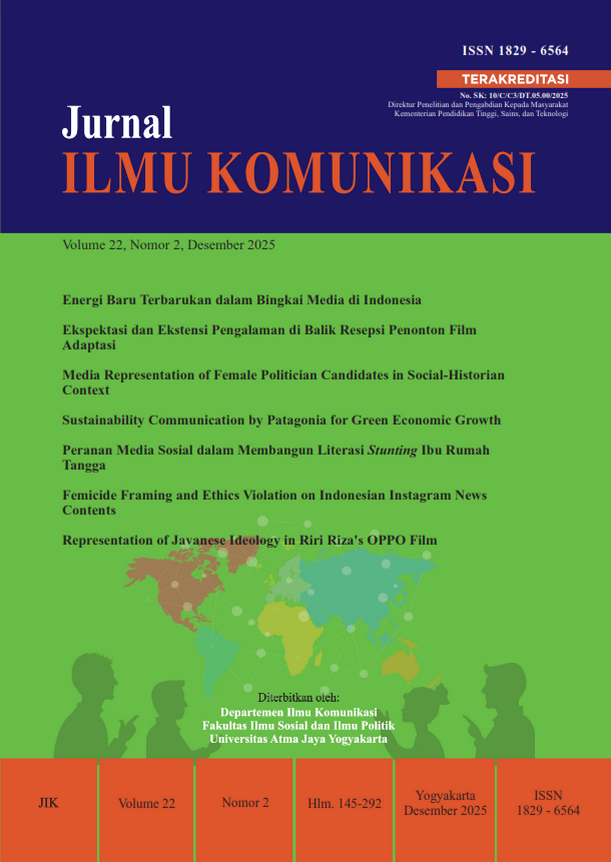
Representation of Javanese Ideology in Riri Riza’s OPPO Film
DOI:
https://doi.org/10.24002/jik.v22i2.10229Keywords:
cinema finders, discourse analysis, Javanese ideology, political body, representationAbstract
The research findings reveal that: (1) at the text level, the representation is conveyed through six signs of low-angle shooting techniques using an Oppo smartphone camera, challenging male ideological dominance in Javanese, European, and Chinese patriarchal ideologies; (2) at the praxis discourse level, the film's production system reflects the generational shift in perception, particularly among Generation Z, within the smartphone content industry; (3) at the discourse context level, it serves as Oppo Indonesia's marketing communication strategy to target the male segment, which is significant in the Indonesian smartphone content industry.
References
Al-Khawaldeh, N. N., Rababah, L. M., Khawaldeh, A. F., & Banikalef, A. A. (2023). The art of rhetoric: Persuasive strategies in Biden’s inauguration speech: A critical discourse analysis. Humanities and Social Sciences Communications, 10(1), 1–8. <https://doi.org/10.1057/s41599-023-02450-y>
Anika, S., Jan R., L., & McGraw, A. P. (2023). The art of slowness: Slow motion enhances consumer evaluations by increasing processing fluency. Journal of Marketing Research, 61(2), 1–9. <https://doi.org/10.1177/00222437231179187>
Arnesson, J. (2023). Influencers as ideological intermediaries: Promotional politics and authenticity labour in influencer collaborations. Media, Culture & Society, 45(3), 528–544. <https://doi.org/10.1177/01634437221117505>
Azhari, D. R., Yoesoef, M., Setyani, T. I., Tinggi, S., Asing, B., & Bandung, Y.-A. (2023). Battle of Islamic women’s discourse through popular culture in post-authoritarian Indonesia. Humanities, Education, and Cultural Studies, 1(1), 20–40. <https://dx.doi.org/10.20961/ijsascs.v6i2.73913>
Badan Pusat Statistik (BPS). (2024). Indikator tujuan pembangunan berkelanjutan Indonesia 2024. <https://www.bps.go.id/id/publication/2024/12/31/936a26d5d2b168b9971d3b02/indikator-tujuan-pembangunan-berkelanjutan-indonesia-2024.html>
Baer, H. (2016). Redoing feminism: Digital activism, body politics, and neoliberalism. Feminist Media Studies, 16(1), 17–34. <https://doi.org/10.1080/14680777.2015.1093070>
Barton, N., & Janis, J. E. (2020). Missing the mark: The state of health care literacy in plastic surgery. Plastic and Reconstructive Surgery – Global Open, 8(5), 1–9. <https://doi.org/10.1097/GOX.0000000000002856>
Broeker, F. (2023). We went from the anonymity of the internet into my private WhatsApp: Rituals of transition among dating app users in Berlin. New Media & Society, 25(10), 2551–2571. <https://doi.org/10.1177/14614448211029200>
Cheng, L., Xu, M., & Ma, G. (2023). Tempo-spatial construction in human-law-society triangle from the perspective of cognitive semiotics. Humanities and Social Sciences Communications, 10(1), 1–10. <https://doi.org/10.1057/s41599-023-02374-7>
Cintas-Peña, M., Luciañez-Triviño, M., Montero, A., R., Bileck, A., Bortel, P., Kanz, F., Rebay-Salisbury, K., & García, S., L. (2023). Amelogenin peptide analyses reveal female leadership in Copper Age Iberia (c. 2900–2650 BC). Scientific Reports, 13(1), 1–8. <https://doi.org/10.1038/s41598-023-36368-x>
Dahl, U. (2023). Creative writing as feminist freedom. European Journal of Women’s Studies, 30(1), 84–89. <https://doi.org/10.1177/13505068221144943>
Depounti, I., Saukko, P., & Natale, S. (2023). Ideal technologies, ideal women: AI and gender imaginaries in Redditors’ discussions on the Replika bot girlfriend. Media, Culture & Society, 45(4), 720–736. <https://doi.org/10.1177/01634437221119021>
Dewi, A. K., & Piliang, Y. A. (2020). Transposition of Drupadi in Garin Nugroho’s Setan Jawa: Woman as a Javanese symbolic act. Melintas: An International Journal of Philosophy and Religion (MIJPR), 36(2), 139–154. <https://doi.org/10.26593/mel.v36i2.5375>
Fajar, D. A. (2022). The representation of the hybridity of Javanese women in the "Tilik" film. PREMISE: Journal of English Education and Applied Linguistics, 11(3), 545–560. <https://doi.org/10.24127/pj.v11i3.5430>
Fairclough, N. L., & Wodak, R. (1997). Critical discourse analysis. In T. A. van Djik (ed.), Discourse studies: A multidisciplinary introduction, vol. 2, discourse as social interaction (pp. 258-284). London, UK: Sage.
Fongesta, B. P., & Aulia, S. (2023). Analisis semiotika iklan pariwisata Labuan Bajo. Kiwari, 2(1), 137–144. <https://doi.org/10.24912/ki.v2i1.23067>
Fu, K. W. (2023). Propagandization of relative gratification: How Chinese state media portray the international pandemic. Political Communication, 40(6), 788–809. <https://doi.org/10.1080/10584609.2023.2207492>
Gilardi, F., Gessler, T., Kubli, M., & Müller, S. (2022). Social media and political agenda setting. Political Communication, 39(1), 39–60. <https://doi.org/10.1080/10584609.2021.1910390>
Hegarty, A. Q. (2024). Gendered framing and representation of women in Irish political television programming during the 2020 formation of the government of Ireland. Feminist Media Studies, 25(4), 898–916. <https://doi.org/10.1080/14680777.2024.2328077>
Heiselberg, M. H., & Raun, T. (2025). Educate yourself! Exploring feminist politics and self-development in Danish online fat activism. Feminist Media Studies, 25(7), 1593–1608. <https://doi.org/10.1080/14680777.2024.2363852>
IDC. (2024). Indonesia’s smartphone market starts the year with a strong 27.4% growth in 1Q24. <https://my.idc.com/getdoc.jsp?containerId=prAP52141324>
Khougar, A., Ahadi, P., & Ahadi, M. (2024). A critical feminist study of mothers raising a child on the autism spectrum in Iran. npj Women’s Health, 2(1), 1–11. <https://doi.org/10.1038/s44294-024-00025-z>
Korniawati, D., & Rahim, A. (2024). The influence of patriarchal culture on social life in Javanese families in Wolio sub-district. Cendikia: Media Jurnal Ilmiah Pendidikan, 14(6), 608–615.
Latifa, I., & Harianto, S. (2023). Studi etnografi virtual kehidupan di balik akun Twitter K-popers dalam perspektif dramaturgi. Communication, 14(1), 40-50. <https://doi.org/10.36080/comm.v14i1.2133>
Lev-On, A. (2023). Making sense of murder: Characterizing stories in social media groups. Media, Culture & Society, 45(8), 1708–1719. <https://doi.org/10.1177/01634437231202151>
Li, Y., & Shao, L. (2024). Using an epidemiological model to explore the interplay between sharing and advertising in viral videos. Scientific Reports, 14(1), 1–11. <https://doi.org/10.1038/s41598-024-61814-9>
Liu, Q. (2025). Sensibility in the world of science and gendered society: The ethics and aesthetics of skin in The Skin I Live In. Studies in European Cinema, 22(2), 190–205. <https://doi.org/10.1080/17411548.2024.2406086>
Maares, P., Banjac, S., & Nölleke, D. (2023). Newsrooms as sites of community and identity: Exploring the importance of material place for journalistic work. Journalism Studies, 24(13), 1611–1628. <https://doi.org/10.1080/1461670X.2023.2241074>
Magnone, D., Niasar, V. J., Bouwman, A. F., Beusen, A. H. W., van der Zee, S. E. A. T. M., & Sattari, S. Z. (2022). The impact of phosphorus on projected Sub-Saharan Africa food security futures. Nature Communications, 13(1), 1–10. <https://doi.org/10.1038/s41467-022-33900-x>
Maharani, S. (2023). Alih kode dan campur kode dalam komunikasi komunitas pecinta film Cinefoxx. Etnolingual, 7(1), 67–91. <https://doi.org/10.20473/etno.v7i1.42387>
Malkawi, R. J., Fareh, S. I., & Rabab’ah, G. (2024). Framing the shooting of Al Jazeera journalist Shireen Abu Akleh in English and Arabic news headlines: A critical discourse study. Humanities and Social Sciences Communications, 11(1), 1–13. <https://doi.org/10.1057/s41599-024-03784-x>
Martin, C. S., Redondo, I. L., & Moncada, L. A. (2024). Fake news and cinema film analysis in Europe and the United States. Studies in Media and Communication, 12(1), 445–456. <https://doi.org/10.11114/smc.v12i1.6741>
Megawati, E. (2021). Analisis wacana kritis model Fairclough dan Wodak pada pidato Prabowo (Critical discourse analysis of Fairclough’s and Wodak’s model within Prabowo’s speech). Kandai, 17(1), 75–90. <https://doi.org/10.26499/jk.v17i1.1551>
Muhamad, N. (2025, July 15). Samsung pimping pengiriman smarphone global kuartal ii 2025. Katadata.co.id. <https://databoks.katadata.co.id/teknologi-telekomunikasi/statistik/6875c203210c9/samsung-pimpin-pengiriman-smartphone-global-kuartal-ii-2025>
Nugroho, O. C., & Yudha, R. (2022). Gemblak stereotype film “Kucumbu Tubuh Indahku” by Garin Nugroho. COMMICAST, 3(3), 266–275. <https://doi.org/10.12928/commicast.v3i2.5734>
Nurahim, T. (2018). Masyarakat Indonesia memiliki smartphone. IndonesiaBaik.id. <https://indonesiabaik.id/infografis/663-masyarakat-indonesia-memiliki-smartphone-8>
OPPO Indonesia & Riza, R (Director). (2021). You and me in low angle [YouTube Video]. <https://www.youtube.com/watch?v=8IPB8NewlfA>
Permana, T., & Puspitaningsih, A. (2021). Studi ekonomi digital di Indonesia. Jurnal Simki Economic, 4(2), 161–<170. https://doi.org/10.29407/jse.v4i2.111>
Pillai, V., & Ghosh, M. (2022). Indian female Twitter influencers’ perceptions of trolls. Humanities and Social Sciences Communications, 9(1), 1–8. <https://doi.org/10.1057/s41599-022-01172-x>
Proust, V. (2023). By sharing our loss, we fight: Collective expressions of grief in the digital age. Media, Culture & Society, 46(2), 393–403. <https://doi.org/10.1177/01634437231207760>
Puorideme, D., & Diedong, A. L. (2023). A socio-cultural discourse study of cultural-political elites’ stances on LGBTI+ identities and practices in Ghana. Humanities and Social Sciences Communications, 10(1), 1–10. <https://doi.org/10.1057/s41599-023-02309-2>
Puspitasari, L., Bajari, A., Hidayat, D. R., & Cho, S. K. (2024). Regional film in the dynamics of the national film industry. ProTVF, 8(2), 116–132. <https://doi.org/10.24198/ptvf.v8i2.54275>
Ribas, D. (2025). Home, family, and violence: The films of João Canijo. Studies in European Cinema, 22(2), 143–158. <https://doi.org/10.1080/17411548.2024.2358674>.
Rohrbach, T., Aaldering, L., & Van der Pas, D. J. (2023). Gender differences and similarities in news media effects on political candidate evaluations: A meta-analysis. Journal of Communication, 73(2), 101–112. <https://doi.org/10.1093/joc/jqac042>.
Santori, P. (2023). Careocracy or isocracy? A feminist alternative to the neoliberal meritocratic discourse. Humanities and Social Sciences Communications, 10(1), 1-9. <https://doi.org/10.1057/s41599-023-02029-7>.
Stier, S., Bleier, A., Lietz, H., & Strohmaier, M. (2018). Election campaigning on social media: Politicians, audiences, and the mediation of political communication on Facebook and Twitter. Political Communication, 35(1), 50–74. <https://doi.org/10.1080/10584609.2017.1334728>
Toni, A. (2019). Wacana kepemimpinan perempuan dalam film Opera Jawa karya Garin Nugroho. Komunika: Jurnal Dakwah dan Komunikasi, 13(2), 137–152. <https://doi.org/10.24090/komunika.v13i2.2072>.
Toni, A. (2025). A Semiotic analysis of marketing communication in advertising film: The case of Riri Riza’s work for OPPO Indonesia. Studies in Media and Communication, 13(2), 306–321. <https://doi.org/10.11114/smc.v13i2.7507>
UNESCO. (2024). Kebaya: Knowledge, skills, traditions and practices. <https://ich.unesco.org/en/RL/kebaya-knowledge-skills-traditions-and-practices-02090>
Walsh, J. P. (2023). Digital nativism: Twitter, migration discourse and the 2019 election. New Media & Society, 25(10), 2618–2643. <https://doi.org/10.1177/14614448211032980>
Wang, J., & Tong, M. (2025). Shanxi Province food security evaluation research. Scientific Reports, 15(1), 1–13. <https://doi.org/10.1038/s41598-024-84725-1>
Weiβ, A. N. (2024). Portrayals of the Shero: A critical discourse analysis on the representation of Wonder Woman and Captain Marvel. Journal of Gender Studies, 34(6), 821–832. <https://doi.org/10.1080/09589236.2024.2360499>
Wibisono, S. (2023). Photography as cinematic ekphrasis: Intermedial study in Garin Nugroho’s Opera Jawa. Harmonia: Journal of Arts Research and Education, 23(1), 64–78. <https://doi.org/10.15294/harmonia.v23i1.39633>
Wijaya, B. S. (2025). Discursive analysis of rejection voices against brand social responsibility initiatives in Indonesia. Humanities and Social Sciences Communications, 12(1), 1–11. <https://doi.org/10.1057/s41599-024-04337-y>
Yoon, M. (2025). A cinematographic analysis of English-dubbed Korean films. Humanities and Social Sciences Communications, 12(1), 1–11. <https://doi.org/10.1057/s41599-025-04425-7>
Zendle, D., Flick, C., Gordon-Petrovskaya, E., Ballou, N., Xiao, L. Y., & Drachen, A. (2023). No evidence that Chinese playtime mandates reduced heavy gaming in one segment of the video games industry. Nature Human Behaviour, 7(10), 1753–1766. <https://doi.org/10.1038/s41562-023-01669-8>
Zhou, N. (2023). Intersemiotic interpretation of demonstrative that in modern TV series. Humanities and Social Sciences Communications, 10(1), 1–10. <https://doi.org/10.1057/s41599-023-02351-0>
Downloads
Published
How to Cite
Issue
Section
License

This work is licensed under a Creative Commons Attribution 4.0 International License.
Jurnal ILMU KOMUNIKASI is an academic journal. As such, it is dedicated to the open exchange of information. For this reason, JIK is freely available to individuals and institutions. Authors who publish in Jurnal ILMU KOMUNIKASI will release their articles under the Creative Commons Attribution (BY) License. This license allows anyone to copy and redistribute the article in any medium or format as well as remix, transform, and build upon the material for any purpose, even commercially as long as they credit the authors for the original creation. For details of the rights authors grants users of their work, see the "human-readable summary" of the license, with a link to the full license. (Note that "you" refers to a user, not an author, in the summary)
 This work is licensed under a Creative Commons Attribution 4.0 International License.