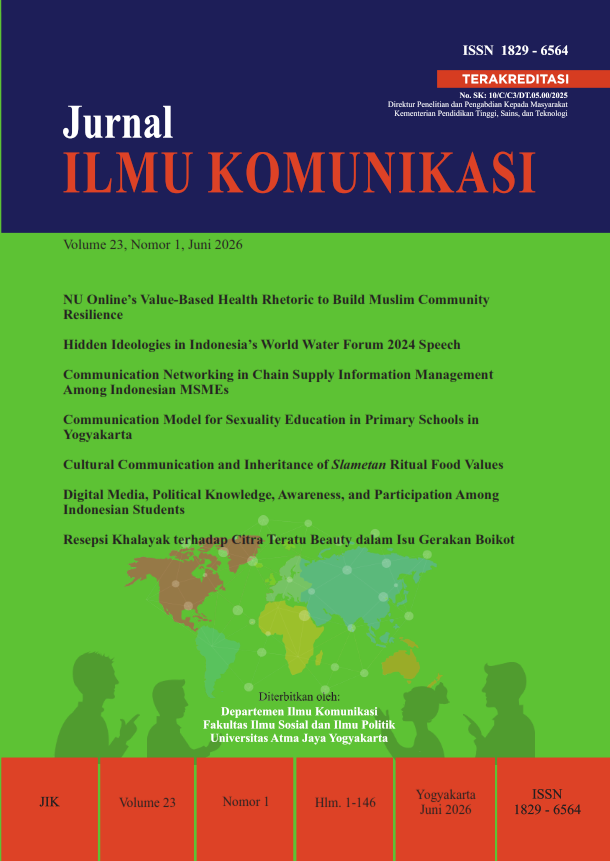
Hidden Ideologies in Indonesia’s World Water Forum 2024 Speech
DOI:
https://doi.org/10.24002/jik.v23i1.11258Keywords:
ecolinguistics, ecology, ideology, Jokowi, World Water ForumAbstract
This study analyzes the ecological and ideological dimensions of President Jokowi’s speech at the World Water Forum 2024 using Norman Fairclough’s critical discourse analysis model and Arran Stibbe’s ecolinguistic framework. The findings reveal an interplay of beneficial, ambivalent, and destructive ideologies. The speech emphasizes moral responsibility and global cooperation in water conservation, while also reflecting economic growth and consumerist ideologies that may undermine ecological sustainability. This study highlights the importance of critical evaluation to promote communication and policymaking aligned with ecological and sustainable principles.
References
Alla, Y. M. K., & Liu, L. (2021). Impacts of dams on the environment: A review. International Journal of Environment, Agriculture and Biotechnology, 6(1), 64-74. https://dx.doi.org/10.22161/ijeab.61.9>
Allard, R. (2024). 10th World Water Forum Highlights. World Water Council. <https://www.worldwatercouncil.org/10th-world-water-forum-highlights/>
Astiti, K. A., Sutajaya, M., Suja, W., Astawa, I. B. M., Suryaningsih, N. M. A., Poerwati, C, E., and Wijaya, I. K. W. B. 2024. Implementation of the Tri Hita Karana concept in the science learning process. Jurnal Penelitian Pendidikan IPA, 10(11): 850–854.
Chawla, S. (2001). Linguistic and philosophical roots of our environmental crisis. In A. Fill, & P. Mühlhäusler (eds.), The ecolinguistics reader: language, ecology, and environment. London, UK: Continuum.
Fairclough, N. (1989). Language and power. London, UK: Longman
-----------------. (1995). Critical discourse analysis: The critical study of language. New York, NY: Longman Publishing.
-----------------. (2004). Analysing discourse: Textual analysis for social research. London, UK: Routledge, Taylor & Francis Group.
-----------------. (2006). Discourse and social change. Cambridge, UK: Polity Press.
-----------------. (2013). Language and power. New York, NY: Routledge, Taylor & Francis Group.
Fill, A., & Muhlhausler, P. (Eds.). (2001). The ecolinguistics reader: Language, ecology and environment. London, UK: Continuum.
Halliday, M. A. K., & Matthiessen, C. M. I. M. (2013). Halliday’s introduction to functional grammar (4th ed). London, UK: Routledge. <https://doi.org/10.4324/9780203431269>
Humas Sekretariat Kabinet Republik Indonesia. (2024). Sambutan Presiden Joko Widodo pada pembukaan Forum Air Sedunia ke-10 tahun 2024, 20 Mei 2024. https://setkab.go.id/pembukaan-forum-air-sedunia-ke-10-tahun-2024-di-bali-international-convention-center-bicc-kabupaten-badung-provinsi-bali-20-mei-2024/
Isaac, J. (2024, April 29). Hydro diplomacy: A solution to global water issues. Indonesia Business Post. <https://indonesiabusinesspost.com/1812/Politics/hydro-diplomacy-a-solution-to-global-water-issues>
JIDHAT Pemerintah Provinsi Bali. (2019). Peraturan Daerah Provinsi Bali Nomor 4 Tahun 2019 tentang Desa Adat di Bali. <https://jidhat.baliprov.go.id/hukum-negara/detail/3>
Koma, F. Y. I. (2021). Water empowerment and conservation for sustainable ecotourism: The case of Bali Jungle Camping. International Journal of Glocal Tourism, 2(4): 241–249. <https://doi.org/10.58982/injogt.v2i4.125>
Mansyur, S. A., Lukmana, I., Isnendes, R., & Gunawan, W. (2021). Eco-critical discourse analysis of the Indonesian President’s statement at the 21st Conference of the Parties in Paris. REiLA: Journal of Research and Innovation in Language, 3(2): 105–114. <https://doi.org/10.31849/reila.v3i2.6285>
Mykhailyuk, O., & Pohlod, H. (2015). The languages we speak affect our perceptions of the world. Journal of Vasyl Stefanyk Precarpathian National University, 2(2–3), 36–41. <https://doi.org/10.15330/jpnu.2.2-3.36-41>
Metro TV. (2024). [Full] High-level meeting KTT World Water Forum ke-10, Bali, 20 Mei 2024 [YouTube Video]. <https://www.youtube.com/watch?v=k0HzXH4uPm4>
Ruggie, J. G. (1992). Multilateralism: The anatomy of an institution. International Organization, 46(3), 561–598. <https://doi.org/10.1017/S0020818300027831>
Rauf, T. (2024, May 1). [Siaran pers World Water Forum ke-10] World Water Forum ke-10 akan dibuka dengan ritual adat khas Bali. Info Publik. <https://infopublik.id/kategori/nusantara/850385/index.html>
Safwat, S. (2015). Speech acts in political speeches. Journal of Modern Education Review, 5, 699–706. <https://doi.org/10.15341/jmer(2155-7993)/07.05.2015/008>
Sekretariat Presiden. (2024). Live: KTT World Water Forum ke-10, Bali, 20 Mei 2024 [YouTube Video]. <https://www.youtube.com/watch?v=iBddGpKhaOE>
Stibbe, A. (2014). An ecolinguistic approach to critical discourse studies. Critical Discourse Studies, 11(1), 117-128. <https://doi.org/10.1080/17405904.2013.845789>
-----------. (2015). Ecolinguistic discourse analysis. In The International Encyclopedia of Language and Social Interaction. Hoboken, NJ: John Wiley & Sons. <https://doi.org/10.1002/9781118611463.wbielsi013>
-----------. (2020). Ecolinguistics: Language, ecology and the stories we live by (2nd ed). New York, NY: Routledge.
UNESCO World Heritage Convention. (2012). Cultural landscape of Bali Province: The subak system as a manifestation of the Tri Hita Karana philosophy. <https://whc.unesco.org/en/list/1194/>
World Water Council. (2024). Ministerial declaration on “water for shared prosperity”. <https://www.worldwatercouncil.org/wp-content/uploads/2025/11/MINISTERIAL-DECLARATION-WWF-10.pdf>
Downloads
Published
How to Cite
Issue
Section
License

This work is licensed under a Creative Commons Attribution 4.0 International License.
Jurnal ILMU KOMUNIKASI is an academic journal. As such, it is dedicated to the open exchange of information. For this reason, JIK is freely available to individuals and institutions. Authors who publish in Jurnal ILMU KOMUNIKASI will release their articles under the Creative Commons Attribution (BY) License. This license allows anyone to copy and redistribute the article in any medium or format as well as remix, transform, and build upon the material for any purpose, even commercially as long as they credit the authors for the original creation. For details of the rights authors grants users of their work, see the "human-readable summary" of the license, with a link to the full license. (Note that "you" refers to a user, not an author, in the summary)
 This work is licensed under a Creative Commons Attribution 4.0 International License.