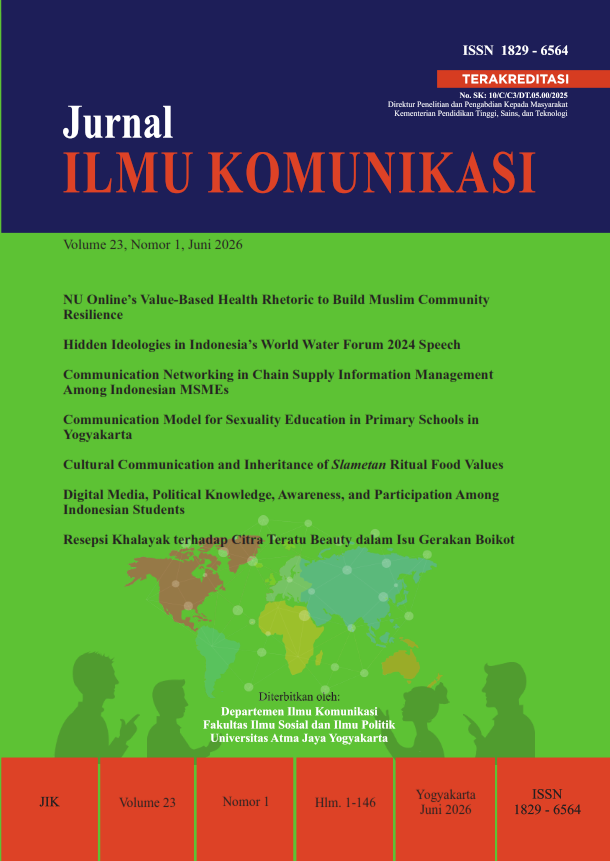
Communication Model for Sexuality Education in Primary Schools in Yogyakarta
DOI:
https://doi.org/10.24002/jik.v23i1.13681Keywords:
children, communication model, primary school, sexuality educationAbstract
This study aims to identify the communication model used in sexuality education for children at elementary schools in the Special Region of Yogyakarta. The data were collected through in-depth interviews and passive observation in three schools: a public school, a religion-based school, and an international school. The findings indicate that all three schools have different communication models of sexuality education depending on each institution’s character. The public school uses a simpler model, where sexuality education is delivered by teachers in a regular class. The private schools involve external parties as speakers and organize a special session to discuss sexuality education.
References
Belton, E., & Hollis, V. (2016). A review of the research on children and young people who display harmful sexual behaviour online. Research report. National Society for the Prevention of Cruelty to Children (NSPCC), London, UK. <https://learning.nspcc.org.uk/media/1198/review-children-young-people-harmful-sexual-behaviour-online.pdf>
Chassiakos, Y. R., Radesky, J., Christakis, D., Moreno, M. A., Cross, C., Hill, D., … Swanson, W. S. (2016). Children and adolescents and digital media. Pediatrics, 138(5), 1–18. <https://doi.org/https://doi.org/10.1542/peds.2016-2593>
Fardhani, L., & El-Yunusi, M. (2025). Peran guru melalui sex education dalam pencegahan tindak kekerasan seksual di SD Santa Maria Sidoarjo. JIKAP PGSD: Jurnal Ilmiah Ilmu Kependidikan, 9(1), 91–96. <https://ojs.unm.ac.id/JIKAP/article/view/67824>
Internet Watch Foundation. (2021). Self-generated child sexual abuse. <https://annualreport2021.iwf.org.uk/trends/selfgenerated>
Ismail, K., & Hamid, S. R. A. (2016). Communication about sex-reproductive health issues with adolescents: A taboo among Malaysian parents?. European Journal of Social Sciences Education and Research, 3(2), 25–46. <https://doi.org/https://doi.org/10.26417/ejser.v6i1.p27-41>
Jayani, D. H. (2022, January 5). 83,85% siswa di jenjang SD hingga SMA beragama Islam. Databoks. <https://databoks.katadata.co.id/demografi/statistik/1ffb89dbeee6747/8385-siswa-di-jenjang-sd-hingga-sma-beragama-islam>
Kementerian Pendidikan Dasar dan Menengah. (2026). Tim pencegahan dan penanganan kekerasan (TPPK) dan satuan tugas pencegahan dan penanganan kekerasan (Satuan tugas). <https://merdekadarikekerasan.kemendikdasmen.go.id/tppk-satgas/>
Kurniawati, L. (2023). Implementasi pendidikan seksual pada anak bawah umur di era milenial. Jurnal Ilmu Sosial dan Pendidikan (JISIP), 7(1), 724-731. <https://doi.org/http://dx.doi.org/10.58258/jisip.v7i1.4712>
Lefevre, M. (2018). Communicating and engaging with children and young people. Bristol, UK: Policy Press. <https://doi.org/10.51952/9781447343561>
Mascheroni, G., & Ólafsson, K. (2014). Net Children Go Mobile: Risks and opportunities. Technical report. Educatt, Milano, Italy. <https://researchonline.lse.ac.uk/id/eprint/55798>
Mediana. (2021). Di balik urgensi pendidikan seksualitas. Kompas.id. <https://www.kompas.id/baca/dikbud/2021/04/21/mengapa-pendidikan-seksualitas-semakin-diperlukan/>
O’donnell, J., Dwisetyani, U., & Mcdonald, P. (2020). Premarital sex and pregnancy in Greater Jakarta. Genus, 76(13), 1–22. <https://doi.org/https://doi.org/10.1186/s41118-020-00081-8>
Potter, W. (2016). Media Literacy (8th ed.). Thousand Oaks, CA: SAGE Publications.
Puspita, E., & Utami, R. D. (2023). Applying sexual education to elementary school children in the digital native era. Didaktika Tauhidi: Jurnal Pendidikan Guru Sekolah Dasar, 10(2), 223–240. <https://doi.org/10.30997/dt.v10i2.9779>
Rahadian, A. S., & Fatoni, Z. (2022). Memecah tabu, melindungi anak dari kekerasan seksual: Pentingnya edukasi kesehatan reproduksi sejak dini. The Conversation. <https://theconversation.com/memecah-tabu-melindungi-anak-dari-kekerasan-seksual-pentingnya-edukasi-kesehatan-reproduksi-sejak-dini-181253>
Safitri, S. (2018). Applying a sex education programme in elementary schools in Indonesia: Theory, application, and best practices. In A. A. Ariyanto, H. Muluk, P. Newcombe, F. P. Piercy, E. K. Poerwandari, & S. H. R. Suradijono, Diversity in unity: Perspectives from psychology and behavioral sciences (pp. 217–223). London, UK: Taylor & Francis Group.
Santhya, K. G., & Jejeebhoy, S. J. (2015). Sexual and reproductive health and rights of adolescent girls: Evidence from low- and middle income countries. Global Public Health, 10(2), 189–221. <https://doi.org/10.1080/17441692.2014.986169>
Schramm, W. (1960). How communication works. In W. Schramm, The process and effects of mass communication (pp. 3-26). Urbana, IL: University of Illinois Press.
Syofiyanti, D., Mudjiran, Asnah, & Jasrial. (2021). Implementation of Sex education for children in elementary school. International Journal on Integrated Education, 4(8), 47–51. <https://journals.researchparks.org/index.php/IJIE/article/view/2122>
Tim Direktorat Sekolah Dasar. (2020). Buku panduan pelaksanaan pendidikan kesehatan reproduksi di sekolah dasar. Jakarta Pusat, Indonesia: Kementrian Pendidikan dan Kebudayaan. <https://sipuswita.mojokertokab.go.id/upload/file/PANDUAN KESPRO SD - FINAL 2020_compressed.pdf>
Tohit, N. F. M., & Haque, M. (2024). Empowering Futures: Intersecting Comprehensive Sexual Education for Children and Adolescents With Sustainable Development Goals. Cureus, 16(7), 1–13. <https://doi.org/10.7759/cureus.65078>
Traub, S. (2016). Communicating effectively with children. <https://extension.missouri.edu/publications/gh6123>
UNESCO. (2018). International technical guidance on sexuality education. Paris, France: United Nations Educational, Scientific and Cultural Organization (UNESCO). <https://www.unfpa.org/sites/default/files/pub-pdf/ITGSE.pdf>
UNICEF. (2017). The state of the world’s children 2017: Children in a digital world. Research report. United Nations Children’s Fund (UNICEF), New York, NY. <https://files.eric.ed.gov/fulltext/ED590013.pdf>
Downloads
Published
How to Cite
Issue
Section
License

This work is licensed under a Creative Commons Attribution 4.0 International License.
Jurnal ILMU KOMUNIKASI is an academic journal. As such, it is dedicated to the open exchange of information. For this reason, JIK is freely available to individuals and institutions. Authors who publish in Jurnal ILMU KOMUNIKASI will release their articles under the Creative Commons Attribution (BY) License. This license allows anyone to copy and redistribute the article in any medium or format as well as remix, transform, and build upon the material for any purpose, even commercially as long as they credit the authors for the original creation. For details of the rights authors grants users of their work, see the "human-readable summary" of the license, with a link to the full license. (Note that "you" refers to a user, not an author, in the summary)
 This work is licensed under a Creative Commons Attribution 4.0 International License.