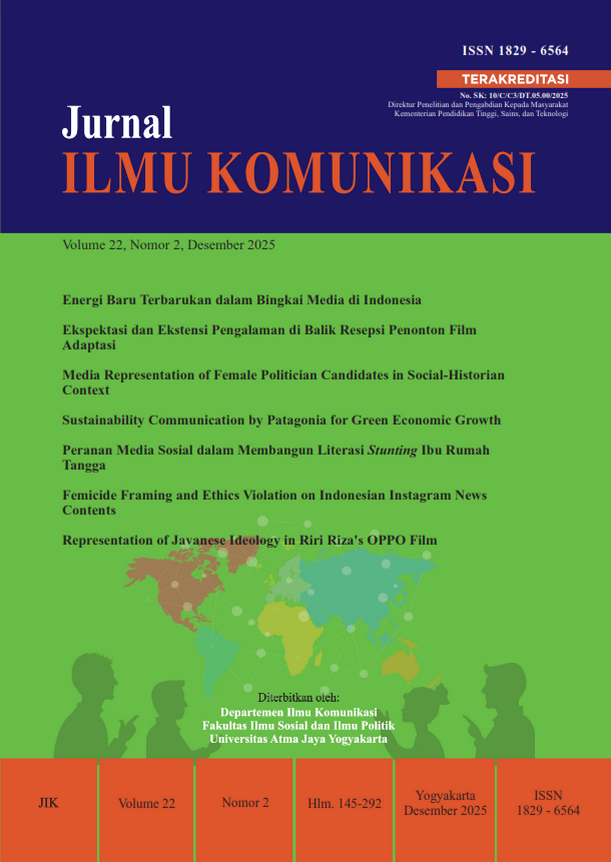
Energi Baru Terbarukan dalam Bingkai Media di Indonesia
DOI:
https://doi.org/10.24002/jik.v22i2.8259Abstract
Polusi udara akibat emisi bahan bakar fosil telah menjadi isu global dan mendorong banyak negara menggunakan energi baru terbarukan (EBT). Studi ini bertujuan antara lain untuk mengetahui bagaimana media membingkai EBT; apakah terdapat perbedaan pembingkaian antara media lama dan media baru dan jenis EBT yang paling banyak mendapat perhatian. Analisa dilakukan dengan menggunakan konsep framing Entman. Artikel yang muncul sejak 2019 hingga 2022 dikumpulkan dengan menggunakan Google Search. Hasil penelitian menunjukkan bingkai ‘untung-rugi’ dan ‘solusi’ muncul sebagai bingkai paling dominan; tidak terdapat perbedaan pembingkaian antara media lama dan media baru. Geothermal dan hydropower adalah jenis EBT yang paling banyak diberitakan
References
Afifa, Arshad, K., Hussain, N., Ashraf, M. H., & Saleem, M. Z. (2024). Air pollution and climate change as grand challenges to sustainability. Science of The Total Environment, 928, 1-19. <https://doi.org/10.1016/j.scitotenv.2024.172370>
Arif, A. (2023, Agustus 31). Polusi udara memperpendek harapan hidup penduduk indonesia. Kompas.id. <https://www.kompas.id/baca/humaniora/2023/08/31/polusi-udara-memperpendek-harapan-hidup-penduduk-indonesia>
Barkemeyer, R., Figge, F., & Holt, D. (2013). Sustainability-related media coverage and socioeconomic development: A regional and north–south perspective. Environment and Planning C: Government and Policy, 31(4), 716–740. <https://doi.org/10.1068/c11176j>
Batel, S., & Devine-Wright, P. (2014). Towards a better understanding of people’s responses to renewable energy technologies: Insights from social representations theory. Public Understanding of Science, 24(3), 311–325. <https://doi.org/10.1177/0963662513514165>
Hermawan, D., Aidil, M., & Lanpito, Y. (2022). Harga BBM subsidi resmi naik, meski pemerintah sudah diperingatkan tentang dampak sosialnya. BBC.com. <https://www.bbc.com/indonesia/indonesia-62728584.>
Bergh, D. (2015). Chi-squared test of fit and sample size-a comparison between a random sample approach and a chi-square value adjustment method. Journal of Applied Measurement, 16(2), 204-217.
Biddinika, M. K., Prawisuda, P., Yoshikawa, K., Tokimatsu, K., & Takahashi, F. (2014). Does Fukushima accident shift public attention toward renewable energy? Energy Procedia, 61, 1372–1375. <https://doi.org/10.1016/j.egypro.2014.12.130>
Birkland, T. (2010). An introduction to the policy process: Theories, concepts, and models of public policy making (4th edition). New York, NY: Routledge
CNN Indonesia (2022, Oktober 3). Dua periode menjabat, Jokowi sudah naikkan harga BBM 6 kali. CNNIndonesia.com. <https://www.cnnindonesia.com/ekonomi/20221003143458-85-855726/dua-periode-menjabat-jokowi-sudah-naikkan-harga-bbm-6-kali.>
Deignan, B., & Hoffman-Goetz, L. (2015). Emotional tone of Ontario newspaper articles on the health effects of industrial wind turbines before and after policy change. Journal of Health Communication, 20(5), 531–538. <https://doi.org/10.1080/10810730.2014.999894>
Devine-Wright, H. (2011). Envisioning public engagement with renewable energy: An empirical analysis of images within the UK national press 2006/2007. Dalam P. Devine-Wright (Ed.), Renewable energy and the public: From nimby to participation (h. 101 – 114). London, UK: Earthscan
Dewan Pers (2020). Pers dan dinamika politik Indonesia. Jurnal Dewan Pers, 21, 1-78. <https://ikhub.id/produk/analisis-kebijakan/jurnal-dewan-pers-vol-21-pers-dan-dinamika-politik-indonesia-94915697>
Djerf-Pierre, M., Cokley, J., & Kuchel, L. J. (2015). Framing renewable energy: A comparative study of newspapers in Australia and Sweden. Environmental Communication, 10(5), 634–655. <https://doi.org/10.1080/17524032.2015.1056542>
Ehlers, M-H., & Sutherland, L-A. (2016). Patterns of attention to renewable energy in the British farming press from 1980 to 2013. Renewable and Sustainable Energy Reviews, 54, 959–973. <https://doi.org/10.1016/j.rser.2015.10.082>
Einsiedel, E. F., Remillard, C., Gomaa, M., & Zeaiter, E. (2015). The representation of biofuels in political cartoons: Ironies, contradictions and moral dilemmas. Environmental Communication, 11(1), 41–62. <https://doi.org/10.1080/17524032.2015.1076017>
Eklöf, J., & Mager, A. (2013). Technoscientific promotion and biofuel policy: How the press and search engines stage the biofuel controversy. Media, Culture & Society, 35(4), 454-471. <https://doi.org/10.1177/0163443713483794>
Entman, R. M. (1993). Framing: toward clarification of a fractured paradigm. Journal of Communication. 43(4), 51–58. <https://doi.org/10.1111/j.1460-2466.1993.tb01304.x>
----------------. (2003). Projections of power: Framing news, public opinion, and U.S. foreign policy. Chicago, USA: University of Chicago Press.
Govindaraju, G. M., Sahadevan, K. J., & Ling, T. P. (2019). Framing analysis of news coverage on renewable energy in the Star online news portal. Journal of Engineering Science and Technology. 18, 33 – 43.
Haigh, M. M. (2010). Newpapers use three frames to cover alternative energy. Newspaper Research Journal, 31(2), 47–62. <https://doi.org/10.1177/073953291003100205>
Hasa (2021). What is the difference between mass media and social media. <https://pediaa.com/what-is-the-difference-between-mass-media-and-social-media/>
Hindmarsh, R. (2013). Hot air ablowin! ‘Media-speak’, social conflict, and the Australian ‘decoupled’ wind farm controversy. Social Studies of Science, 44(2), 194-217. <https://doi.org/10.1177/0306312713504239>
Jepperson, R. L. (2008). Institutions, institutional effects and institutionalism. Dalam Water W. Powel dan Paul J. DiMaggio (ed), The new institutionalism in organizational analysis (h. 164-182). Chicago, IL: University of Chicago Press
Kerlinger, F. N. (2000). Foundations of behavioral research (4th ed.). New York, USA: Holt, Rinehart & Winston
Kim, G., & Kim, S. (2023). Does the Fukushima nuclear accident still matter? Analysis of its mediated effects on five dimensions of nuclear power acceptance by using the parallel multiple mediator model. Energy Strategy Reviews, 49(1), 101168, 1-14. <https://doi.org/10.1016/j.esr.2013.03.006>
Kim, S. H., Besley, J. C., Oh, S. H., & Kim, S. Y. (2014). Talking about bio-fuel in the news: Newspaper framing of ethanol stories in the United States. Journalism Studies, 15(2), 218-234. <https://doi.org/10.1080/1461670X.2013.809193>
Larcinese, V., Puglisi, R., & Snyder, J. M. (2011). Partisan bias in economic news: Evidence on the agenda-setting behavior of U.S. newspapers. Journal of Public Economics, 95(9–10), 1178–1189. <https://doi.org/10.1016/j.jpubeco.2011.04.006>
Liebe, U., & Dobers, G. M. (2019). Decomposing public support for energy policy: What drives acceptance of and intentions to protest against renewable energy expansion in Germany?. Energy Research & Social Science, 47, 247-260. <https://doi.org/10.1016/j.erss.2018.09.004>
Liu, L., Bouman, T., Perlaviciute, G., & Steg, L. (2019). Effects of trust and public participation on acceptability of renewable energy projects in the Netherlands and China. Energy Research & Social Science. 53, 137–144. <https://doi.org/10.1016/j.erss.2019.03.006>
Matthes, J., & Kohring, M. (2008). The content analysis of media frames: Toward improving reliability and validity. Journal of Communication. 58(2), 258–279. < https://doi.org/10.1111/j.1460-2466.2008.00384.x>
Napoli, P. M. (2014). Automated media: An institutional theory perspective on algorithmic media production and consumption. Communication Theory, 24(3), 340–360. <https://doi.org/10.1111/comt.12039>
Olson-Hazboun, S. K., Krannich, R. S., & Robertson, P. G. (2016). Public views on renewable energy in the rocky mountain region of the United States: Distinct attitudes, exposure, and other key predictors of wind energy. Energy Research & Social Science, 21, 167–179. <https://doi.org/10.1016/j.erss.2016.07.002>
Park, D. J., Wang, W., & Pinto, J. (2016). Beyond disaster and risk: Post-Fukushima nuclear news in U.S. and German press. Communication, Culture and Critique, 9(3), 417–437. <https://doi.org/10.1111/cccr.12119>
Rochyadi-Reetz, M., Arlt, D., Wolling, J., & Bräuer, M. (2019). Explaining the media's framing of renewable energies: an international comparison. Frontiers in Environmental Science, 7(119), 1-12. <https://doi.org/10.3389/fenvs.2019.00119>
Rochyadi-Reetz, M. & Wolling, J. (2023). Environmental communication publications in indonesia’s leading communication journals: A systematic review. Jurnal Aspikom, 8(1), 15-28. <http://dx.doi.org/10.24329/aspikom.v8i1.1210>
Romanach, L., Carr-Cornish, S., & Muriuki, G. (2015). Societal acceptance of an emerging energy technology: How is geothermal energy portrayed in Australian media? Renewable and Sustainable Energy Reviews, 42, 1143–1150. <https://doi.org/10.1016/j.rser.2014.10.088>
Schuck, A. R. T., & de Vreese, C. H. (2006). Between risk and opportunity: News framing and its effects on public support for EU enlargement. European Journal of Communication, 21(1), 5-32. <https://doi.org/10.1177/0267323106060987>
Semetko, H. A. & Valkenburg, P. M. (2000). Framing European politics: A content analysis of press and television news. Journal of Communication, 50(2), 93-109. <https://doi.org/10.1111/j.1460-2466.2000.tb02843.x>
Shoemaker, P. J., & Reese, S. D. (1991). Mediating the message: Theories of influences on mass media content. New York, NY: Longman Publishers
--------------------------------------. (2014). Mediating the message in the 21st century: A media sociology perspective. New York, NY: Routledge.
Skjølsvold, T. M. (2012). Curb your enthusiasm: On media communication of bioenergy and the role of the news media in technology diffusion. Environmental Communication: A Journal of Nature and Culture. 6(4), 512–531. <https://doi.org/10.1080/17524032.2012.705309>
Smith, H. M., Smith, J. W., Silka, L., Lindenfeld, L., & Gilbert, C. (2016). Media and policy in a complex adaptive system: Insights from wind energy legislation in the United States. Energy Research & Social Science, 19, 53–60. <https://doi.org/10.1016/j.erss.2016.05.016>
Stauffacher, M., Muggli, N., Scolobig, A., & Moser, C. (2015). Framing deep geothermal energy in mass media: The case of Switzerland. Technological Forecasting and Social Change, 98, 60–70. https://doi.org/10.1016/j.scitotenv.2024.172370
van Dijk, T. A. (2015). Critical Discourse Analysis. In D. Tannen, H.E. Hamilton, & D. Schiffrin (Eds.), The Handbook of Discourse Analysis (2nd ed., Vol. 1, pp. 466–485). John Wiley & Sons. https://onlinelibrary.wiley.com/doi/book/10.1002/9781118584194
Wibawa, D. (2022). Mengapa pemerintah menaikkan harga BBM? Badan pendidikan dan pelatihan keuangan. Kemenkeu.go.id. <https://klc2.kemenkeu.go.id/kms/knowledge/mengapa-pemerintah-menaikkan-harga-bbm-7efa3d7f/detail/>
Wimmer, R. D., & Dominick, J. R. (2009). Mass media research: An introduction. Boston, MA: Cengage Learning
Downloads
Published
How to Cite
Issue
Section
License

This work is licensed under a Creative Commons Attribution 4.0 International License.
Jurnal ILMU KOMUNIKASI is an academic journal. As such, it is dedicated to the open exchange of information. For this reason, JIK is freely available to individuals and institutions. Authors who publish in Jurnal ILMU KOMUNIKASI will release their articles under the Creative Commons Attribution (BY) License. This license allows anyone to copy and redistribute the article in any medium or format as well as remix, transform, and build upon the material for any purpose, even commercially as long as they credit the authors for the original creation. For details of the rights authors grants users of their work, see the "human-readable summary" of the license, with a link to the full license. (Note that "you" refers to a user, not an author, in the summary)
 This work is licensed under a Creative Commons Attribution 4.0 International License.