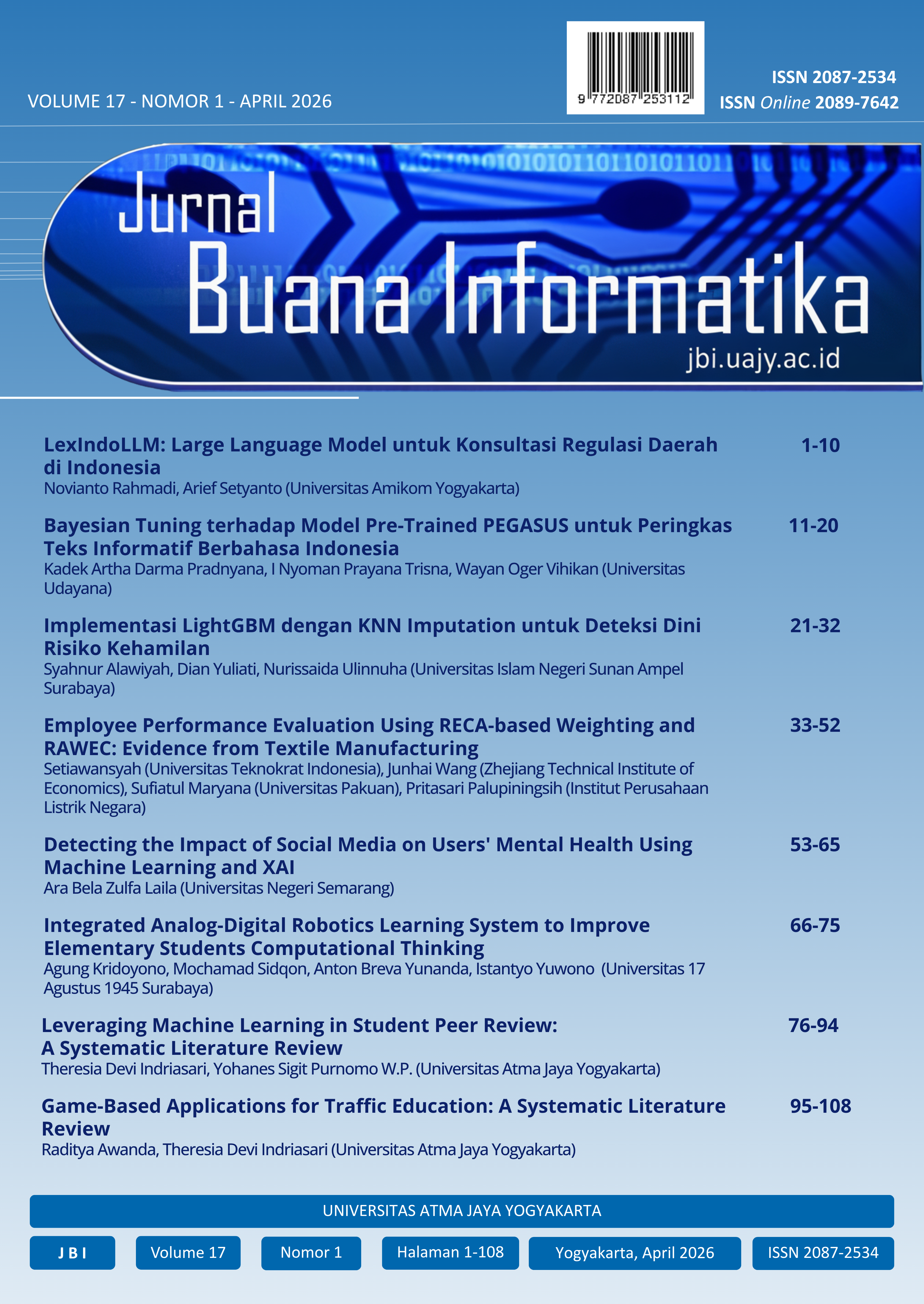
Integrated Analog-Digital Robotics Learning System to Improve Elementary Students Computational Thinking
DOI:
https://doi.org/10.24002/jbi.v17i1.14470Keywords:
Educational Robotics System, Analog Digital Robots, Computational Thinking, Sistem Robotika Pendidikan, Berpikir KomputasiAbstract
This study explores the implementation of an integrated analog–digital robotics learning model to improve computational thinking skills among elementary school students. The learning activities were arranged progressively, starting from analog sensor-based robotics experiments and continuing to programmable digital robot control. A total of 30 fifth-grade students participated in a four-week intervention program involving hands-on robotics activities. Students’ computational thinking abilities were evaluated through four dimensions: decomposition, pattern recognition, abstraction, and algorithmic thinking. The findings revealed improvements in all assessed indicators. The average score increased from 61.3 on the pretest to 82.7 on the posttest, with a medium normalized gain (N-gain) of 0.55. Statistical analysis using a paired-sample t-test also showed a significant difference between pretest and posttest scores (p < 0.05). These results indicate that integrated robotics learning can provide meaningful support for developing computational thinking skills in primary education.
Penelitian ini mengeksplorasi penerapan model pembelajaran robotika analog-digital terpadu untuk meningkatkan kemampuan berpikir komputasi pada siswa sekolah dasar. Kegiatan pembelajaran disusun secara progresif, dimulai dari eksperimen robotika berbasis sensor analog dan dilanjutkan dengan pengendalian robot digital yang dapat diprogram. Sebanyak 30 siswa kelas lima berpartisipasi dalam program intervensi empat minggu yang melibatkan aktivitas robotika langsung. Kemampuan berpikir komputasi siswa dievaluasi melalui empat dimensi: dekomposisi, pengenalan pola, abstraksi, dan berpikir algoritmik. Temuan ini menunjukkan adanya perbaikan pada seluruh indikator yang dinilai. Nilai rata-rata meningkat dari 61,3 pada pretest menjadi 82,7 pada posttest, dengan gain ternormalisasi sedang (N-gain) sebesar 0,55. Analisis statistik menggunakan uji-t berpasangan juga menunjukkan perbedaan yang signifikan antara skor pretest dan posttest (p < 0,05). Hasil tersebut menunjukkan bahwa pembelajaran robotika terpadu dapat memberikan dukungan yang berarti bagi pengembangan keterampilan berpikir komputasi pada pendidikan dasar.
References
[1] K. A. Nugraha, “Penerapan Optical Character Recognition untuk Pengenalan Variasi Teks pada Media Presentasi Pembelajaran,” Jurnal Buana Informatika, vol. 15, no. 1, pp. 69–78, 2024.
[2] A. Valls Pou, X. Canaleta, and D. Fonseca, “Computational Thinking and Educational Robotics Integrated into Project-Based Learning.,” Sensors (Basel, Switzerland), vol. 22, no. 10, May 2022, doi: 10.3390/s22103746.
[3] E. Antony, A. Neenu, and E. Ijmtst, “Robotics as an Educational Tool,” International Journal for Modern Trends in Science and Technology, vol. 8, pp. 254–257, Feb. 2022, doi: 10.46501/IJMTST0802041.
[4] M. Sidqon, A. Kridoyono, and A. B. Yunanda, “Enhancing Elementary Students ’ Robotics Understanding and Learning Engagement via Creative Project-Based Activities at SDN Margorejo 1 Surabaya,” Jurnal Reka Elkomika, vol. 6, no. 3, pp. 282–291, 2025.
[5] A. Buditjahjanto, F. Baskoro, and G. Sudarto, “Computational Thinking Effect on Students’ Computer Simulation Abilities in Terms of Learning Outcomes,” SAR Journal - Science and Research, pp. 16–22, Mar. 2025, doi: 10.18421/SAR81-02.
[6] M. Yousif and X. Jiang, “A Human-Robot Interaction in Education: A Systematic Review of Furhat Robots Role in Student Learning,” Artificial Intelligence & Robotics Development Journal, pp. 337–352, Mar. 2025, doi: 10.52098/airdj.20255136.
[7] S. Papadakis, “The Impact of Coding Apps to Support Young Children in Computational Thinking and Computational Fluency. A Literature Review,” Frontiers in Education, vol. 6, p. 657895, Jun. 2021, doi: 10.3389/feduc.2021.657895.
[8] S. Al-Nawaiseh, A. Tabieh, W. Maqableh, M. Altawalbeh, and F. Bani Ahmad, “The effectiveness of using educational robots in enhancing engineering mathematics skills among students in basic school,” International Journal of Education and Practice, vol. 12, pp. 2311–6897, May 2024, doi: 10.18488/61.v12i3.3768.
[9] D. Dimosthenopoulos, F. P. Basamakis, C. Glykos, A. C. Bavelos, G. Mountzouridis, and S. Makris, “A Digital Twin-based paradigm for programming and control of cooperating robots in reconfigurable production systems,” International Journal of Computer Integrated Manufacturing, vol. 38, no. 10, pp. 1443–1463, Oct. 2025, doi: 10.1080/0951192X.2024.2428683.
[10] H. Choi, H. Kim, and N. Kim, “Enhancing creativity through a problem-based design thinking project in higher education,” Cogent Education, vol. 11, no. 1, p. 2378272, Dec. 2024, doi: 10.1080/2331186X.2024.2378272.
[11] A. Marquardt Donovan and E. Fyfe, “Connecting concrete objects and abstract symbols promotes children’s place value knowledge,” Educational Psychology journal, vol. 42, pp. 1–19, May 2022, doi: 10.1080/01443410.2022.2077915.
[12] M. Funk et al., “A simple interactive robot to promote computational thinking,” Frontiers in Computer Science, vol. Volume 4-2022, 2022, doi: 10.3389/fcomp.2022.1022778.
[13] S. Y. Yang, Y. C. Lin, and Y. T. Lin, “Improving Elementary Students’ Computational Thinking Skills through an Educational Robot Intervention: A Quasi-Experimental Study,” International Journal of Learning, Teaching and Educational Research, vol. 23, no. 9, pp. 343–360, 2024, doi: 10.26803/ijlter.23.9.18.
[14] S. Danoebroto, W. Wahyudi, O. Ulloa, R. Rizky, A. Syaifuddin, and R. Araya, “Unleashing computational thinking: a novel approach to reforming Indonesian primary math instruction,” Frontiers in Education, vol. 11, Mar. 2026, doi: 10.3389/feduc.2026.1754373.
[15] S. Amri, C. Budiyanto, K. Fenyvesi, R. Yuana, and I. Widiastuti, “Educational Robotics: Evaluating the Role of Computational Thinking in Attaining 21st Century Skills,” Open Education Studies, vol. 4, pp. 322–338, Oct. 2022, doi: 10.1515/edu-2022-0174.
[16] N. Pratiwi, E. Ahman, D. Disman, and H. Mulyadi, “Exploration of Constructivist Learning Models in Developing Critical Thinking Skills: A Systematic Literature Review,” AL-ISHLAH: Jurnal Pendidikan, vol. 17, Jun. 2025, doi: 10.35445/alishlah.v17i2.6538.
[17] F. Triani and A. Asrizal, “Development of Basic Electronics E-Modules Integrated with Problem Solving Models to Improve Students’ Mastery of Concepts and Creative Thinking,” Jurnal Penelitian Pendidikan IPA, vol. 9, pp. 88–94, Dec. 2023, doi: 10.29303/jppipa.v9iSpecialIssue.5880.
[18] M. Arafat, C. Budiyanto, R. Yuana, and K. Fenyvesi, “Implementation of Integrated STEM Learning in Educational Robotics towards 21st Century Skills: A Systematic Review,” International Journal of Education in Mathematics, Science and Technology, vol. 12, pp. 1127–1141, Nov. 2024, doi: 10.46328/ijemst.4271.
[19] A. Kridoyono, “Simple Electronic System of Security for a 24-Hour Grocery Store,” Applied Technology and Computing Science Journal, vol. 6, no. 1, pp. 1–10, 2023, doi: 10.33086/atcsj.v6i1.4583.
[20] K. Liakos and F. Plessas, “Analog Design and Machine Learning: A Review,” Electronics, vol. 14, p. 3541, Sep. 2025, doi: 10.3390/electronics14173541.
[21] K. kalam, “Line Follower Robot with Obstacle Avoidance,” INTERANTIONAL JOURNAL OF SCIENTIFIC RESEARCH IN ENGINEERING AND MANAGEMENT, vol. 08, pp. 1–5, May 2024, doi: 10.55041/IJSREM33248.
[22] W. Brigido and J. M. Parente de Oliveira, “The line follower robot: a meta-analytic approach,” PeerJ Computer Science, vol. 11, p. e2744, Mar. 2025, doi: 10.7717/peerj-cs.2744.
[23] A. Escamilla, J. Melenchón, C. Monzo, J. A. Morán, and J. P. Carrascal, “Exploring a user-centered approach for movement-based features in interaction design,” International Journal of Human-Computer Studies, vol. 211, p. 103802, 2026, doi: https://doi.org/10.1016/j.ijhcs.2026.103802.
[24] Z. Saleem, F. Gustafsson, E. Furey, M. McAfee, and S. Huq, “A review of external sensors for human detection in a human robot collaborative environment,” Journal of Intelligent Manufacturing, vol. 36, pp. 2255–2279, Apr. 2024, doi: 10.1007/s10845-024-02341-2.
Downloads
Published
Issue
Section
License

This work is licensed under a Creative Commons Attribution-ShareAlike 4.0 International License.
Copyright of this journal is assigned to Jurnal Buana Informatika as the journal publisher by the knowledge of author, whilst the moral right of the publication belongs to author. Every printed and electronic publications are open access for educational purposes, research, and library. The editorial board is not responsible for copyright violation to the other than them aims mentioned before. The reproduction of any part of this journal (printed or online) will be allowed only with a written permission from Jurnal Buana Informatika.
This work is licensed under a Creative Commons Attribution-ShareAlike 4.0 International License.