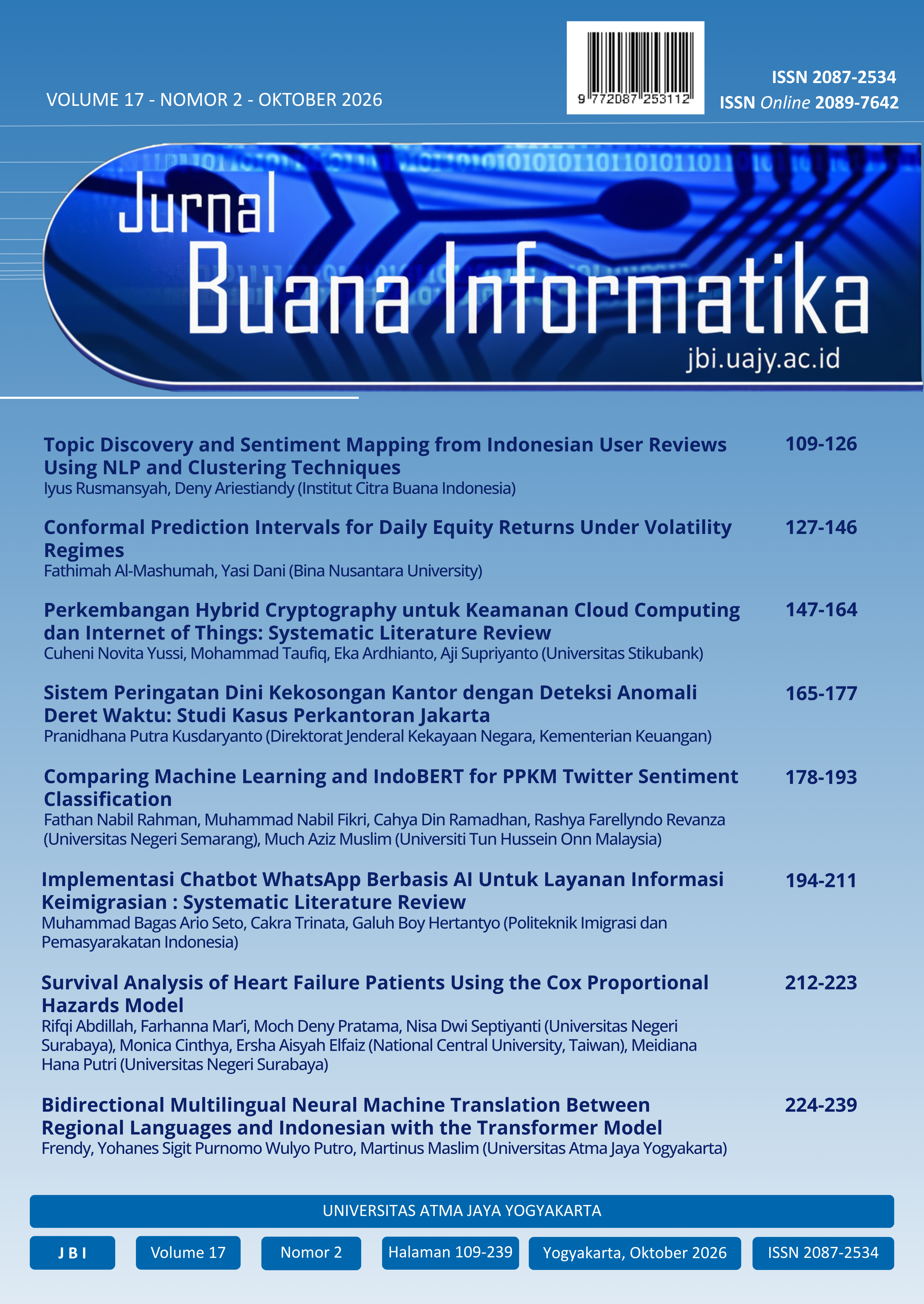
Bidirectional Multilingual Neural Machine Translation Between Regional Languages and Indonesian with the Transformer Model
DOI:
https://doi.org/10.24002/jbi.v17i2.15344Keywords:
Machine Translation, Multilingual, Neural Machine Translation, Regional Languages, Transformer, Bahasa DaerahAbstract
The limited digital linguistic resources for Indonesian regional languages remain a major obstacle to developing high-quality automatic translation systems. This study presents an empirical comparison of three multilingual Transformer based Neural Machine Translation (NMT) models, mT5, ByT5, and NLLB, for bidirectional translation between five Indonesian regional languages (Javanese, Sundanese, Balinese, Minangkabau, and Dayak Maanyan) and Indonesian under low-resource conditions. Using approximately 4,000 sentence pairs per language, the three models were evaluated with BLEU and ChrF++. Results show the bilingual baseline consistently outperformed the bidirectional multilingual approach across all three architectures, with NLLB proving most resilient to this degradation and achieving the strongest overall result (BLEU 62.16, ChrF++ 79.93) in controlled, domain-specific settings. This study contributes preliminary empirical evidence on architecture selection for low-resource regional language translation, constrained by dataset size and the absence of human evaluation.
Minimnya sumber daya linguistik digital untuk bahasa daerah Indonesia menjadi kendala utama dalam pengembangan sistem penerjemahan otomatis yang berkualitas. Penelitian ini menyajikan perbandingan empiris tiga model Neural Machine Translation (NMT) multilingual berbasis Transformer, yaitu mT5, ByT5, dan NLLB, untuk penerjemahan dua arah antara lima bahasa daerah Indonesia (Jawa, Sunda, Bali, Minangkabau, dan Dayak Maanyan) dan Bahasa Indonesia pada kondisi data terbatas. Menggunakan sekitar 4.000 pasangan kalimat per bahasa, ketiga model dievaluasi dengan BLEU dan ChrF++. Hasil menunjukkan model bilingual baseline secara konsisten mengungguli pendekatan multilingual bidirectional pada ketiga arsitektur, dengan NLLB paling tangguh terhadap penurunan performa dan mencatat hasil terbaik keseluruhan (BLEU 62,16; ChrF++ 79,93); hasil ini berlaku untuk kondisi yang terkontrol dan spesifik-domain. Penelitian ini memberikan bukti empiris awal mengenai pemilihan arsitektur untuk penerjemahan bahasa daerah, dengan keterbatasan pada ukuran dataset dan absennya evaluasi manusia.
References
[1] C. Moseley and A. Nicolas, Atlas of the world’s languages in danger. UNESCO, 2010.
[2] R. Ramli, F. H. Setyawan, and R. Rampeng, “The threat of lingua globalization towards vernaculars in South Sulawesi,” ETNOSIA: Jurnal Etnografi Indonesia, vol. 6, no. 2, Dec. 2021, doi: 10.31947/etnosia.v6i2.18197.
[3] A. W. Mahastama, “Model Berbasis Aturan untuk Transliterasi Bahasa Jawa dengan Aksara Latin ke Aksara Jawa,” Jurnal Buana Informatika, vol. 13, no. 02, pp. 146–154, Oct. 2022, doi: 10.24002/jbi.v13i02.6526.
[4] L. Susanto, R. Diandaru, A. Krisnadhi, A. Purwarianti, and D. Wijaya, “Replicable Benchmarking of Neural Machine Translation (NMT) on Low-Resource Local Languages in Indonesia,” in Proceedings of the First Workshop in South East Asian Language Processing, Nusa Dua: Association for Computational Linguistics, Nov. 2023, pp. 100–115. doi: 10.18653/v1/2023.sealp-1.8.
[5] C. Samuel and I. T. Ali, “Batak Toba language-Indonesian machine translation with transfer learning using no language left behind,” International Journal of Advances in Applied Sciences, vol. 13, no. 4, pp. 830–839, Dec. 2024, doi: 10.11591/ijaas.v13.i4.pp830-839.
[6] Q. Wang and J. Zhang, “Parameter Differentiation based Multilingual Neural Machine Translation,” ArXiv, Dec. 2021, doi: 10.48550/arXiv.2112.13619.
[7] W. Wongso, A. Joyoadikusumo, B. S. Buana, and D. Suhartono, “Many-to-Many Multilingual Translation Model for Languages of Indonesia,” IEEE Access, vol. 11, pp. 91385–91397, 2023, doi: 10.1109/ACCESS.2023.3308818.
[8] Y. Denny Prabowo, M. Maslim, Y. S. Purnomo W.P., and V. Citrayasa, “Korpus Paralel Dwibahasa Indonesia–Dayak Ma’anyan: Dataset Terjemahan Kalimat Lintas Domain,” Sep. 2026, Zenodo. doi: 10.5281/zenodo.22499315.
[9] Y. Denny Prabowo, M. Maslim, Y. S. Purnomo W.P., and V. Citrayasa, “Korpus Paralel Dwibahasa Indonesia–Bali: Dataset Terjemahan Kalimat Lintas Domain,” Sep. 2026, Zenodo. doi: 10.5281/zenodo.22498298.
[10] Y. Denny Prabowo, M. Maslim, Y. S. Purnomo W.P., and V. Citrayasa, “Korpus Paralel Dwibahasa Indonesia–Minang: Dataset Terjemahan Kalimat Lintas Domain,” Sep. 2026, Zenodo. doi: 10.5281/zenodo.22496100.
[11] Y. Denny Prabowo, M. Maslim, Y. S. Purnomo W.P., and V. Citrayasa, “Korpus Paralel Dwibahasa Indonesia–Sunda: Dataset Terjemahan Kalimat Lintas Domain,” Sep. 2026, Zenodo. doi: 10.5281/zenodo.22494444.
[12] Y. Denny Prabowo, M. Maslim, Y. S. Purnomo W.P., and V. Citrayasa, “Korpus Paralel Dwibahasa Indonesia–Jawa: Dataset Terjemahan Kalimat Lintas Domain,” Sep. 2026, Zenodo. doi: 10.5281/zenodo.22490458.
[13] N. Bhadwal, P. Agrawal, and V. Madaan, “A Machine Translation System from Hindi to Sanskrit Language using Rule based Approach,” Scalable Computing: Practice and Experience, vol. 21, no. 3, pp. 543–554, Aug. 2020, doi: 10.12694/scpe.v21i3.1783.
[14] D. Torregrosa et al., “Aspects of Terminological and Named Entity Knowledge within Rule-Based Machine Translation Models for Under-Resourced Neural Machine Translation Scenarios,” ArXiv, vol. abs/2009.13398, p., Sep. 2020.
[15] A. Way, “A Critique of Statistical Machine Translation,” Linguistica Antverpiensia, New Series – Themes in Translation Studies, vol. 8, pp. 17–41, Oct. 2021, doi: 10.52034/lanstts.v8i.243.
[16] L. Macken and E. Lefever, “Translational equivalence in Statistical Machine Translation or meaning as co-occurrence,” Linguistica Antverpiensia, New Series – Themes in Translation Studies, vol. 7, pp. 193–208, Oct. 2021, doi: 10.52034/lanstts.v7i.215.
[17] J. Dugonik, M. Sepesy Maučec, D. Verber, and J. Brest, “Reduction of Neural Machine Translation Failures by Incorporating Statistical Machine Translation,” Mathematics, vol. 11, no. 11, p. 2484, May 2023, doi: 10.3390/math11112484.
[18] A. Vaswani et al., “Attention Is All You Need,” ArXiv, Aug. 2023, doi: https://doi.org/10.48550/arXiv.1706.03762.
[19] C. Fang, A. Zhou, and Z. Wang, “An Algorithm–Hardware Co-Optimized Framework for Accelerating N:M Sparse Transformers,” IEEE Trans. Very Large Scale Integr. VLSI Syst., vol. 30, pp. 1573–1586, 2022, doi: 10.1109/tvlsi.2022.3197282.
[20] M. Costa-Jussà et al., “Scaling neural machine translation to 200 languages,” Nature, vol. 630, pp. 841–846, 2024, doi: 10.1038/s41586-024-07335-x.
[21] C. Mullov, Q. Pham, and A. Waibel, “Decoupled Vocabulary Learning Enables Zero-Shot Translation from Unseen Languages,” in Proceedings of the 62nd Annual Meeting of the Association for Computational Linguistics (Volume 1: Long Papers), Bangkok, Thailand: Association for Computational Linguistics, Aug. 2024, pp. 6693–6709. doi: 10.18653/v1/2024.acl-long.362.
[22] L. B. San, H. Sujaini, and T. Tursina, “Uji Nilai Akurasi pada Neural Machine Translation (NMT) Bahasa Indonesia ke Bahasa Tiochiu Pontianak dengan Mekanisme Attention Bahdanau,” Jurnal Edukasi dan Penelitian Informatika (JEPIN), vol. 9, no. 3, p. 362, Dec. 2023, doi: 10.26418/jp.v9i3.63346.
[23] R. B. Primandhika, M. N. Munawar, and A. R. Saifullah, “Experiment on a Transformer Model Indonesian-to-Sundanese Neural Machine Translation with Sundanese Speech Level Evaluation,” in Proceedings of the Thirteenth Conference on Applied Linguistics (CONAPLIN 2020), 2021. doi: 10.2991/assehr.k.210427.069.
[24] M. Giri, R. Adjie, R. Dwiyansaputra, F. Bimantoro, and A. Aranta, “Algorithm Design for Converting Indonesian Latin to Sasak Latin Using the Sequence-To-Sequence Transformers Method,” Journal of Computer Science and Informatics Engineering, vol. 9, no. 1, Jun. 2025, doi: 10.29303/jcosine.v9i1.619.
[25] L. Xue et al., “mT5: A Massively Multilingual Pre-trained Text-to-Text Transformer,” in Proceedings of the 2021 Conference of the North American Chapter of the Association for Computational Linguistics: Human Language Technologies, Stroudsburg, PA, USA: Association for Computational Linguistics, Mar. 2021, pp. 483–498. doi: 10.18653/v1/2021.naacl-main.41.
[26] L. Xue et al., “ByT5: Towards a Token-Free Future with Pre-trained Byte-to-Byte Models,” Trans. Assoc. Comput. Linguist., vol. 10, pp. 291–306, Mar. 2022, doi: 10.1162/tacl_a_00461.
[27] R. K. Mahabadi, Y. Belinkov, and J. Henderson, “Variational Information Bottleneck for Effective Low-Resource Fine-Tuning,” Jun. 2021, doi: 10.48550/arXiv.2106.05469.
Downloads
Published
Issue
Section
License

This work is licensed under a Creative Commons Attribution-ShareAlike 4.0 International License.
Copyright of this journal is assigned to Jurnal Buana Informatika as the journal publisher by the knowledge of author, whilst the moral right of the publication belongs to author. Every printed and electronic publications are open access for educational purposes, research, and library. The editorial board is not responsible for copyright violation to the other than them aims mentioned before. The reproduction of any part of this journal (printed or online) will be allowed only with a written permission from Jurnal Buana Informatika.
This work is licensed under a Creative Commons Attribution-ShareAlike 4.0 International License.