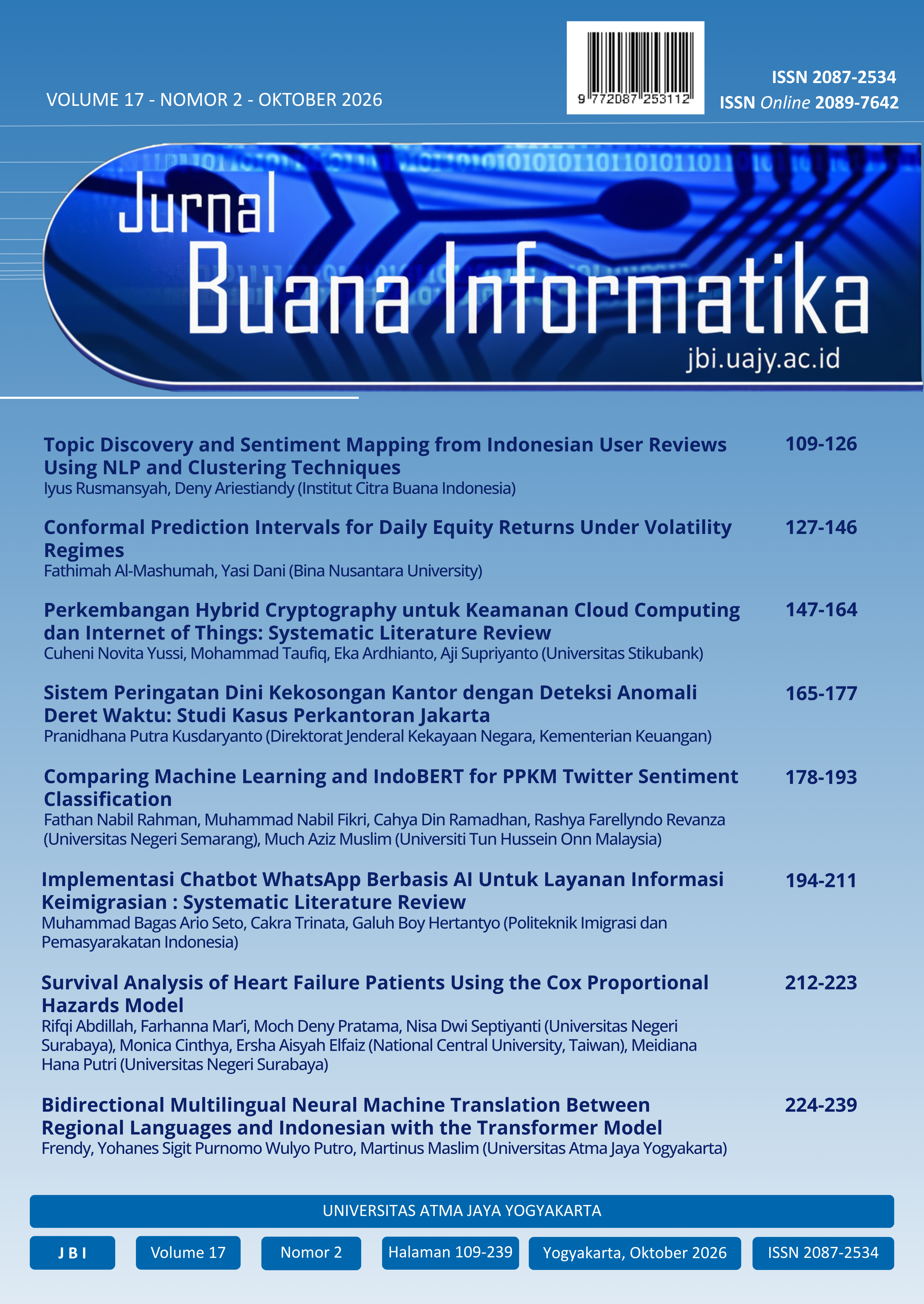
Survival Analysis of Heart Failure Patients Using the Cox Proportional Hazards Model
DOI:
https://doi.org/10.24002/jbi.v17i2.15734Keywords:
Heart Failure, Survival Analysis, Cox Proportional Hazards, Kaplan–Meier, Survival PredictionAbstract
This study applies the Cox Proportional Hazards model to analyze survival outcomes in heart failure patients using the Heart Failure Clinical Records dataset. Kaplan–Meier analysis used to estimate survival probabilities, Cox regression employed to identify significant clinical risk factors. The fitted full-cohort model yielded apparent Concordance Index of 0.7408, whereas held-out test evaluation from stratified 75:25 train–test split yielded a mean time-dependent AUC of 0.7506 and Integrated Brier Score of 0.1658. Age, serum creatinine, high blood pressure, anaemia, creatinine phosphokinase, and ejection fraction were identified as significant predictors of mortality. The results indicate that survival analysis provides more comprehensive prognostic information than binary classification because it estimates both mortality risk and patient survival probability. This approach also support patient risk stratification and facilitate more targeted clinical decision-making. This approach provides interpretable framework for patient risk profiling and individualized survival estimation, but external validation is required before clinical use.
Penelitian ini menerapkan model Cox Proportional Hazards untuk menganalisis ketahanan hidup pasien gagal jantung menggunakan dataset Heart Failure Clinical Records. Analisis Kaplan–Meier digunakan untuk mengestimasi probabilitas ketahanan hidup, regresi Cox digunakan untuk mengidentifikasi faktor risiko klinis yang signifikan. Model full-cohort menghasilkan apparent Concordance Index sebesar 0,7408, evaluasi pada held-out test set dari stratified 75:25 train–test split menghasilkan mean time-dependent AUC sebesar 0,7506 dan Integrated Brier Score sebesar 0,1658. Usia, serum creatinine, hipertensi, anemia, creatinine phosphokinase, dan ejection fraction menjadi prediktor signifikan terhadap mortalitas. Hasil penelitian menunjukkan bahwa analisis survival memberikan informasi prognosis yang lebih komprehensif dibandingkan klasifikasi biner karena mampu mengestimasi risiko kematian dan probabilitas ketahanan hidup. Pendekatan ini juga dapat mendukung stratifikasi risiko pasien serta pengambilan keputusan klinis yang lebih terarah. Pendekatan ini memberikan kerangka yang dapat diinterpretasikan untuk profil risiko dan estimasi survival individual, tetapi memerlukan validasi eksternal sebelum digunakan untuk mendukung keputusan klinis.
References
[1] B. Shahim, C. J. Kapelios, G. Savarese, and L. H. Lund, “Global Public Health Burden of Heart Failure: An Updated Review,” Cardiac Failure Review, vol. 9, Jul. 2023, doi: 10.15420/cfr.2023.05.
[2] Z. Zhang, D. Li, J. Zhao, H. Ma, F. Wang, and Q. Hao, “Enhanced Prediction of Cardiovascular Disease Through Integrated Machine Learning Models Combining Clinical and Demographic Characteristics,” Diagnostics, vol. 16, no. 10, p. 1572, May 2026, doi: 10.3390/diagnostics16101572.
[3] Z. Xu et al., “The Efficacy of Machine Learning Models for Predicting the Prognosis of Heart Failure: A Systematic Review and Meta-Analysis,” Cardiology, pp. 1–19, Apr. 2024, doi: 10.1159/000538639.
[4] S. Tedesco et al., “Comparison of Machine Learning Techniques for Mortality Prediction in a Prospective Cohort of Older Adults,” International Journal of Environmental Research and Public Health, vol. 18, no. 23, p. 12806, Dec. 2021, doi: 10.3390/ijerph182312806.
[5] E. Kokori et al., “Machine learning in predicting heart failure survival: a review of current models and future prospects,” Heart Failure Reviews, vol. 30, no. 2, pp. 431–442, Dec. 2024, doi: 10.1007/s10741-024-10474-y.
[6] R. A. Andika and C. Dewi, “Importance of Feature Selection for Multiple Disease Classification,” Jurnal Buana Informatika, vol. 16, no. 01, pp. 34–45, Apr. 2025, doi: 10.24002/jbi.v16i01.11354.
[7] R. Abdillah, R. Sarno, T. Choirul Amri, F. Atoil Haq, K. Rossa Sungkono, and D. Sunaryono, “Clustering of Photoplethysmography Data Signals for Developing Noise Filters,” in 2023 International Conference on Artificial Intelligence in Information and Communication (ICAIIC), IEEE, Feb. 2023, pp. 303–308. doi: 10.1109/ICAIIC57133.2023.10066966.
[8] K. I. Pattan, D. Anil, K. Sandhya, A. S. Shobitha, M. N. Bala, and B. S. Santhosha, “Predictive Evaluation of Heart Failure Outcomes Using Comparative Machine Learning Models,” in 2026 International Conference on Smart Futuristic Technology, IEEE, Jan. 2026, pp. 1–6. doi: 10.1109/ICSFT66733.2026.11508078.
[9] R. Blythe, R. Parsons, A. G. Barnett, D. Cook, S. M. McPhail, and N. M. White, “Prioritising deteriorating patients using time-to-event analysis: prediction model development and internal–external validation,” Critical Care, vol. 28, no. 1, p. 247, Jul. 2024, doi: 10.1186/s13054-024-05021-y.
[10] B. Roy, T. Stepišnik, C. Vens, and S. Džeroski, “Survival Analysis with Semi-Supervised Predictive Clustering Trees,” Computers in Biology and Medicine, vol. 141, p. 105001, Feb. 2022, doi: 10.1016/j.compbiomed.2021.105001.
[11] S. A. ElHafeez, G. D’Arrigo, D. Leonardis, M. Fusaro, G. Tripepi, and S. Roumeliotis, “Methods to Analyze Time‐to‐Event Data: The Cox Regression Analysis,” Oxidative Medicine and Cellular Longevity, vol. 2021, no. 1, Jan. 2021, doi: 10.1155/2021/1302811.
[12] M. S. K, J. Preetha, K. N. Reddy, S. Ramya, Y. S, and S. Murugan, “Survival Analysis with Cox Proportional Hazards Model in Predicting Patient Outcomes,” in 2024 5th International Conference on Electronics and Sustainable Communication Systems (ICESC), IEEE, Aug. 2024, pp. 1155–1161. doi: 10.1109/ICESC60852.2024.10689732.
[13] T. Ahmad, A. Munir, S. H. Bhatti, M. Aftab, and M. A. Raza, “Survival Analysis of Heart Failure Patients: A Case Study,” PLOS ONE, vol. 12, no. 7, p. e0181001, Jul. 2017, doi: 10.1371/journal.pone.0181001.
[14] A. V. G. Putrie, L. Azzahra, A. Kurniawan, and T. Saifudin, “Survival analysis in heart failure patient using the Kaplan Meier methods,” World Journal of Advanced Research and Reviews, vol. 25, no. 1, pp. 1540–1546, Jan. 2025, doi: 10.30574/wjarr.2025.25.1.0170.
[15] T. Mahama, “Fitting Cox proportional hazard models to identify mortality predictors during pregnancy and postpartum periods,” World Journal of Advanced Research and Reviews, vol. 26, no. 3, pp. 027–047, Jun. 2025, doi: 10.30574/wjarr.2025.26.3.2152.
[16] D. J. McLernon et al., “Assessing Performance and Clinical Usefulness in Prediction Models with Survival Outcomes: Practical Guidance for Cox Proportional Hazards Models,” Annals of Internal Medicine, vol. 176, no. 1, pp. 105–114, Jan. 2023, doi: 10.7326/M22-0844.
[17] Z. Wang and X. Wang, “Evaluating Time-Dependent Predictive Accuracy for Time-to-Event Outcomes with a Cure Fraction,” Pharmaceutical Statistics, vol. 19, no. 6, pp. 955–974, Nov. 2020, doi: 10.1002/pst.2048.
Downloads
Published
Issue
Section
License

This work is licensed under a Creative Commons Attribution-ShareAlike 4.0 International License.
Copyright of this journal is assigned to Jurnal Buana Informatika as the journal publisher by the knowledge of author, whilst the moral right of the publication belongs to author. Every printed and electronic publications are open access for educational purposes, research, and library. The editorial board is not responsible for copyright violation to the other than them aims mentioned before. The reproduction of any part of this journal (printed or online) will be allowed only with a written permission from Jurnal Buana Informatika.
This work is licensed under a Creative Commons Attribution-ShareAlike 4.0 International License.