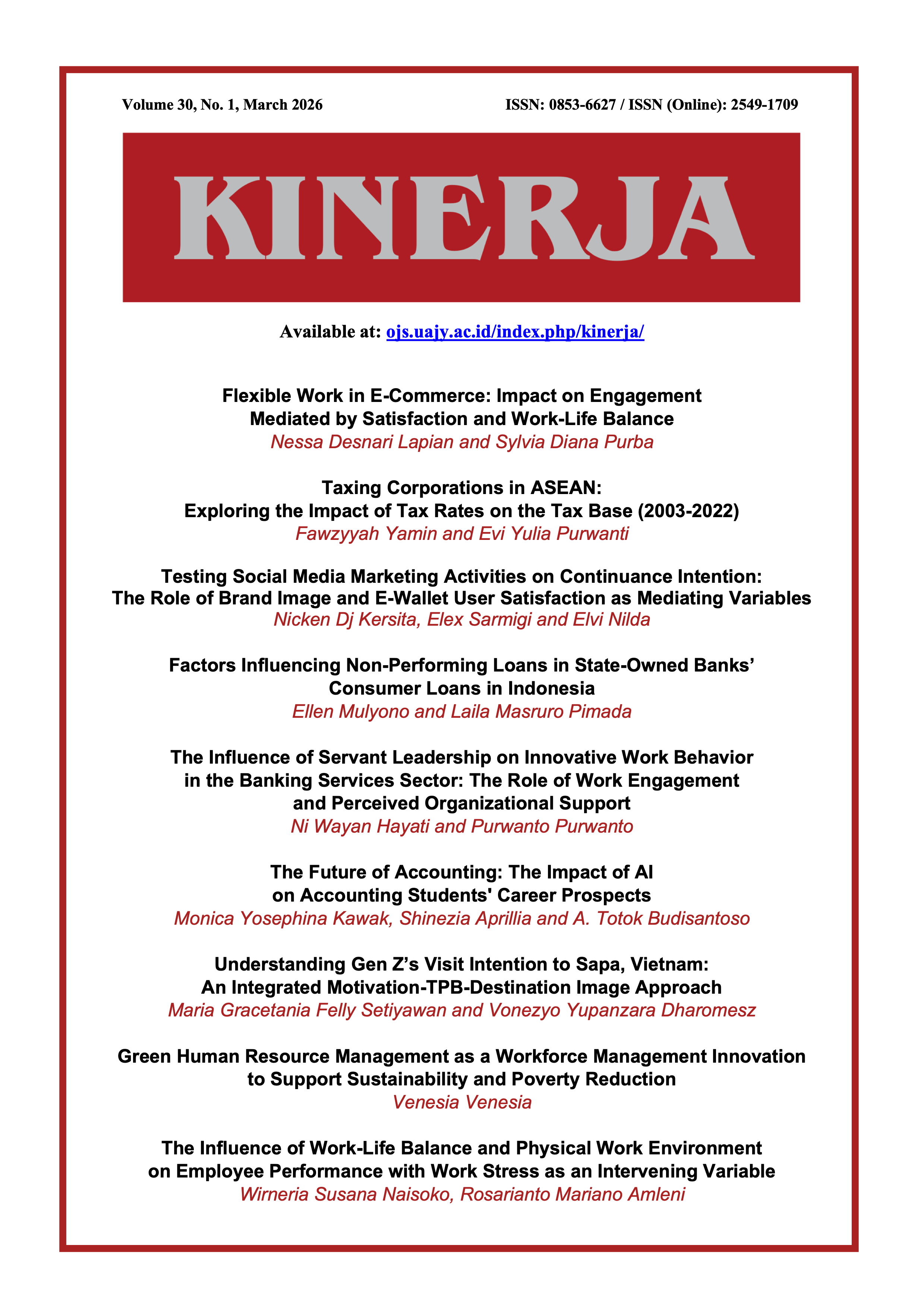
Taxing Corporations in ASEAN: Exploring the Impact of Tax Rates on the Tax Base (2003-2022)
DOI:
https://doi.org/10.24002/kinerja.v30i1.10847Keywords:
corporate income tax, tax base, ASEAN, instrumental variables, tax policyAbstract
This study investigates the impact of corporate income tax rate (CIT) reductions on the corporate tax base in four ASEAN countries, Indonesia, Malaysia, Singapore, and Thailand, from 2003 to 2022. Despite CIT reductions aimed at attracting investment and enhancing competitiveness, corporate tax revenue in the region has stagnated, raising concerns about the effectiveness of these policies. Using a two-stage least squares (2SLS) regression with instrumental variables to address potential endogeneity, the study examines the relationship between the corporate tax base and various factors, including CIT rates, lagged corporate tax base, other countries' CIT rates, top personal income tax rates, export prices, labor costs, and economic growth. Findings reveal that the statutory corporate income tax rate does not have a statistically significant effect on the corporate tax base, suggesting that changes in headline tax rates alone do not explain variations in corporate taxable income in ASEAN countries. In contrast, the average corporate income tax rate of neighboring countries has a significant negative effect on the domestic tax base, indicating the presence of regional tax competition. Other control variables, including labor costs, export prices, and the top personal income tax rate, are statistically insignificant, suggesting that institutional and structural factors shape the corporate tax base. The study contributes by providing region-specific evidence that corporate tax base dynamics in ASEAN are shaped more by cross-border tax interactions and institutional persistence than by domestic rate adjustments. From a policy perspective, the findings suggest that strengthening tax administration, broadening the tax base, and enhancing regional coordination may be more effective than unilateral changes in statutory tax rates.
References
Abelson, P. (2012). Public economics: Principles and practice (3rd ed.). McGraw-Hill Education. https://appliedeconomics.com.au/wp-content/uploads/2021/10/public-economics-principles-and-practice-book-by-peter-abelson.pdf
Agustina, N. Z., & Hartono, D. (2022). Dampak perubahan tarif pajak penghasilan badan dan pajak pertambahan nilai di Indonesia. EKUITAS (Jurnal Ekonomi dan Keuangan), 6(4), 456–475. https://doi.org/10.24034/j25485024.y2022.v6.i4.5359
Basri, M. C., Felix, M., Hanna, R., & Olken, B. A. (2019). Tax administration vs. tax rates: Evidence from corporate taxation in Indonesia (NBER Working Paper No. 26150). National Bureau of Economic Research. https://doi.org/10.3386/w26150
Benitez, J. C., Mansour, M., Pecho, M., & Vellutini, C. (2023, September). Building tax capacity in developing countries (IMF Staff Discussion Note No. 2023/006). International Monetary Fund. https://www.imf.org/-/media/Files/Publications/SDN/2023/English/SDNEA2023006
Brauner, Y., & Stewart, M. (2013). Introduction: Tax, law and development. In Y. Brauner & M. Stewart (Eds.), Tax, law and development (pp. 3–22). Edward Elgar. https://ssrn.com/abstract=2208161
Buettner, T. (2003). Tax base effects and fiscal externalities of local capital taxation: Evidence from a panel of German jurisdictions. Journal of Urban Economics, 54(1), 110–128. https://doi.org/10.1016/S0094-1190(03)00039-1
Cai, H., & Liu, Q. (2009). Competition and corporate tax avoidance: Evidence from Chinese industrial firms. The Economic Journal, 119(537), 764–795. https://doi.org/10.1111/j.1468-0297.2009.02217.x
Clausing, K. A. (2016). The effect of profit shifting on the corporate tax base in the United States and beyond. National Tax Journal, 69(4), 905–934. https://doi.org/10.17310/ntj.2016.4.09
Dahlby, B., & Ferede, E. (2012). The effects of tax rate changes on tax bases and the marginal cost of public funds for Canadian provincial governments. International Tax and Public Finance, 19(6), 844–883. https://doi.org/10.1007/s10797-012-9210-7
de Mooij, R. A., & Nicodème, G. (2008). Corporate tax policy and incorporation in the EU. International Tax and Public Finance, 15(4), 478–498. https://doi.org/10.1007/s10797-008-9072-1
Devereux, M. P. (2007). Developments in the taxation of corporate profit in the OECD since 1965: Rates, bases and revenues (Working Paper No. 07/04). Oxford University Centre for Business Taxation.
Devereux, M. P., Liu, L., & Loretz, S. (2014). The elasticity of corporate taxable income: New evidence from UK tax records. American Economic Journal: Economic Policy, 6(2), 19–53. https://doi.org/10.1257/pol.6.2.19
Dharmapala, D. (2008). What problems and opportunities are created by tax havens? Oxford Review of Economic Policy, 24(4), 661–679. https://doi.org/10.1093/oxrep/grn031
Feldstein, M. (1995). Behavioral responses to tax rates: Evidence from TRA86 (NBER Working Paper No. 5000). National Bureau of Economic Research. https://doi.org/10.3386/w5000
Fossen, F. M., & Steiner, V. (2018). The tax-rate elasticity of local business profits. German Economic Review, 19(2), 162–189. https://doi.org/10.1111/geer.12123
Gordon, R. H., & MacKie-Mason, J. K. (1995). Why is there corporate taxation in a small open economy? The role of transfer pricing and income shifting. In M. Feldstein, J. R. Hines Jr., & R. G. Hubbard (Eds.), The effects of taxation on multinational corporations (pp. 67–94). University of Chicago Press. https://doi.org/10.7208/9780226241876-005
Gordon, R. H., MacKie-Mason, J. K., & Hubbard, R. G. (1995). The importance of income shifting to the design and analysis of tax policy. In M. Feldstein, J. R. Hines Jr., & R. G. Hubbard (Eds.), Taxing multinational corporations (pp. 29–38). University of Chicago Press. https://www.nber.org/books-and-chapters/taxing-multinational-corporations/importance-income-shifting-design-and-analysis-tax-policy
Gruber, J. (2016). Public finance and public policy (5th ed.). Worth Publishers.
Guritno, M. (1999). Ekonomi publik (3rd ed.). BPFE-Yogyakarta.
Hidayat, A. (2014). Analisis dampak perubahan tarif pajak penghasilan di Indonesia. Jurnal BPPK: Badan Pendidikan dan Pelatihan Keuangan, 7(1), 1–18. https://jurnalbppk.kemenkeu.go.id/jurnalbppk/article/view/83
Hyman, D. N. (2010). Public finance: A contemporary application of theory to policy (10th ed.). South-Western Cengage Learning.
International Monetary Fund. (2024). World economic outlook database, October 2024 edition [Data set]. https://www.imf.org/en/Publications/WEO/weo-database/2024/October
James, S., & Nobes, C. (1992). The economics of taxation (4th ed.). Prentice Hall.
Janeba, E., & Smart, M. (2003). Is targeted tax competition less harmful than its remedies? International Tax and Public Finance, 10(3), 259–280. https://doi.org/10.1023/A:1023887530597
Karpowicz, A., & Majewska, E. (2018). Corporate income tax revenue determinants: How important is the tax rate? In M. B. Beros, N. Reckler, & M. Kozina (Eds.), Economic and Social Development: Book of Proceedings (pp. 361–369). Varazdin Development and Entrepreneurship Agency. https://www.proquest.com/conference-papers-proceedings/corporate-income-tax-revenue-determinants-how/docview/2057944111/se-2?accountid=49069
Kawano, L., & Slemrod, J. (2016). How do corporate tax bases change when corporate tax rates change? With implications for the tax rate elasticity of corporate tax revenues. International Tax and Public Finance, 23, 401–433. https://doi.org/10.1007/s10797-015-9375-y
Krapf, M., & Staubli, D. (2025). Regional variations in corporate tax responsiveness: Evidence from Switzerland. European Economic Review, 171, 104891. https://doi.org/10.1016/j.euroecorev.2024.104891
Laffer, A. B. (2004). The Laffer curve: Past, present, and future (Executive Summary No. 1765). The Heritage Foundation. https://www.heritage.org/taxes/report/the-laffer-curve-past-present-and-future
Mankiw, N. G. (2010). Macroeconomics (7th ed.). Worth Publishers.
Mankiw, N. G. (2013). Principles of microeconomics (7th ed.). Cengage Learning.
Matsumoto, M. (2022). Tax competition and tax base equalization in the presence of multiple tax instruments. International Tax and Public Finance, 29(5), 1213–1226. https://doi.org/10.1007/s10797-021-09703-z
Meita, I., & Nurdiniah, D. (2023). The effect of changes in corporate income tax rates, inflation and interest rates on income tax revenues. Jurnal Pajak dan Keuangan Negara (PKN), 4(2), 563–570. https://doi.org/10.31092/jpkn.v4i2.2033
Mintz, J. M. (2022). The global corporate minimum tax: A cure or not? Canadian Tax Journal / Revue fiscale canadienne, 70(Supplement), 231–255. https://doi.org/10.32721/ctj.2022.70.supp.mintz
Musgrave, R. A., & Musgrave, P. B. (1989). Public finance in theory and practice (5th ed.). McGraw-Hill.
Natalia, M., Carolina, V., & Joni, J. (2021). Relationship between corporate social responsibility disclosure, corporate governance, and tax avoidance. KINERJA, 25(1), 79–90. https://doi.org/10.24002/kinerja.v25i1.4198
Nguyen, J. H. (2022). How do labor adjustment costs affect corporate tax planning? Evidence from labor skills. International Review of Financial Analysis, 83, 102293. https://doi.org/10.1016/j.irfa.2022.102293
Organisation for Economic Co-operation and Development. (2024). Revenue statistics in Asia and the Pacific 2024: Tax revenue buoyancy in Asia. https://doi.org/10.1787/e4681bfa-en
Pindyck, R. S., & Rubinfeld, D. L. (2018). Microeconomics (9th ed.). Pearson Education.
PwC. (2018, May 30). Singapore - Corporate - Tax credits and incentives. PwC Worldwide Tax Summaries. https://taxsummaries.pwc.com/singapore/corporate/tax-credits-and-incentives
Pitaloka, R. B., & Slamet, K. (2025). CIT rate and tax holiday as tax competition tools to attract inward FDI in ASEAN-6. KINERJA, 29(2), 164–188. https://doi.org/10.24002/kinerja.v29i2.10723
Ramsey, F. P. (1927). A contribution to the theory of taxation. The Economic Journal, 37(145), 47–61. https://doi.org/10.2307/2222721
Rasji, R., Liane, W. S., & Nainggolan, D. H. (2023). Analisis pengaruh perubahan penurunan tarif pajak penghasilan (PPh) wajib pajak badan terhadap pendapatan negara. NUSANTARA: Jurnal Ilmu Pengetahuan Sosial, 10(5), 2323–2332. https://jurnal.um-tapsel.ac.id/index.php/nusantara/article/view/11626
Riedl, A., & Rocha-Akis, S. (2009). Testing the tax competition theory: How elastic are national tax bases in OECD countries? (CESifo Working Paper No. 2669). https://doi.org/10.2139/ssrn.1423748
Stiglitz, J. E. (1999). Economics of the public sector (3rd ed.). W. W. Norton & Company.
Sumomba, C. R., & Hutomo, Y. S. (2012). Pengaruh beban pajak tangguhan dan perencanaan pajak terhadap manajemen laba. KINERJA, 16(2), 103–115. https://doi.org/10.24002/kinerja.v16i2.361
Tax Foundation (2023, December 12). Corporate tax rates around the world, 2023. https://taxfoundation.org/data/all/global/corporate-tax-rates-by-country-2023/
Thomas, K. D. (2017). User-friendly taxpaying. Indiana Law Journal, 92(4), 1509–1558. https://www.repository.law.indiana.edu/ilj/vol92/iss4/5/
Tobing, G. C., & Mukarromah, A. (2015, June). Pajak dalam kompetisi merebut investasi. InsideTax, 32, 6–15. https://ddtc.co.id/uploads/pdf/InsideTax-32nd-Edition.pdf
Wooldridge, J. M. (2013). Introductory econometrics: A modern approach (5th ed.). Cengage Learning.
World Bank. (2020). Doing business 2020: Comparing business regulation in 190 economies. https://doi.org/10.1596/978-1-4648-1440-2
Downloads
Published
Issue
Section
License
Copyright (c) 2026 Fawzyyah Yamin, Evi Yulia Purwanti

This work is licensed under a Creative Commons Attribution 4.0 International License.