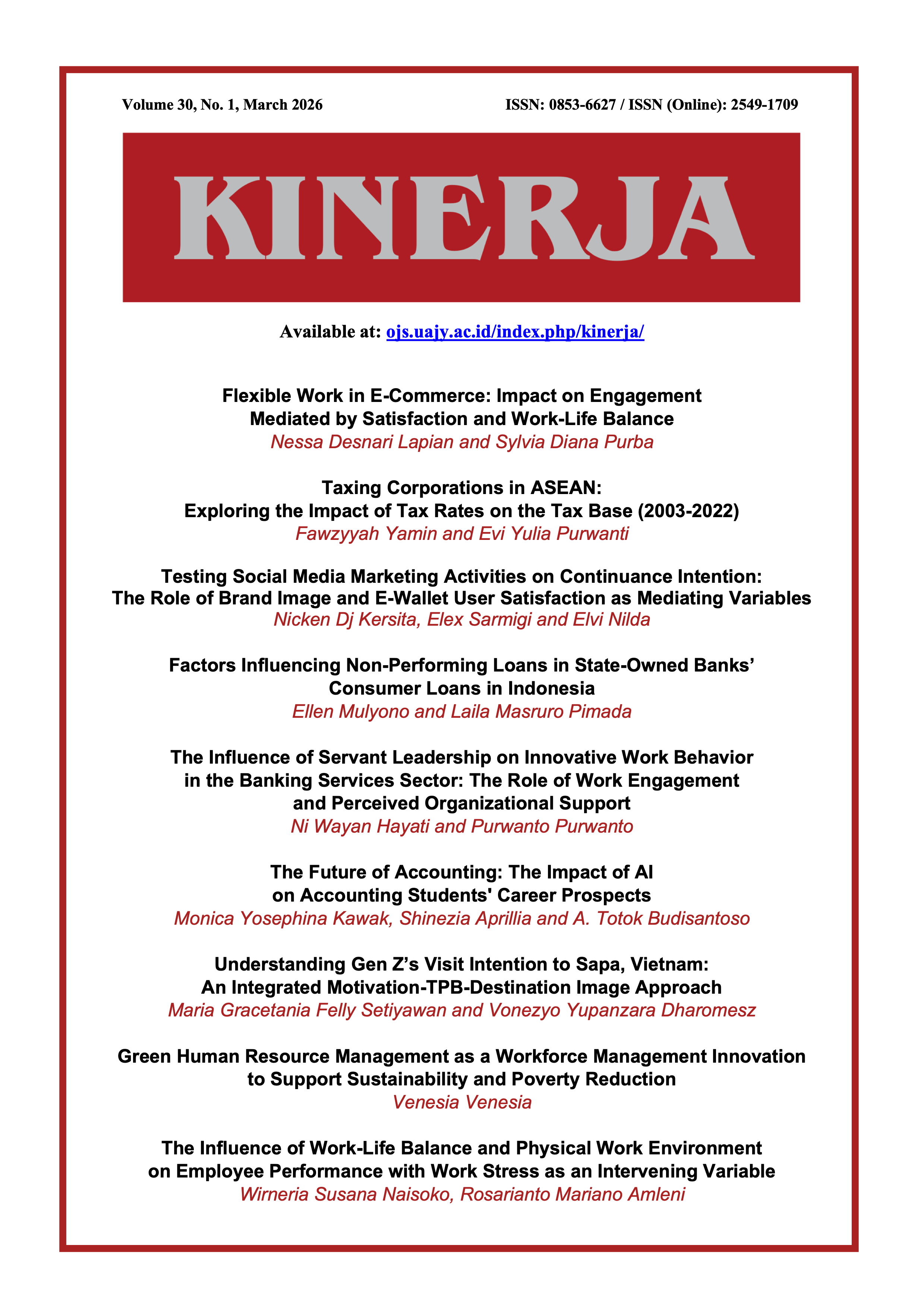
Understanding Gen Z’s Visit Intention to Sapa, Vietnam: An Integrated Motivation-TPB-Destination Image Approach
DOI:
https://doi.org/10.24002/kinerja.v30i1.13349Keywords:
theory of planned behavior, pull motivation, push motivation, destination image, visit intention, destination choice, gen zAbstract
This study examines Gen Z's intention to visit Sapa, Vietnam, focusing on the M-TPB-D framework and push and pull theory of motivation. Gen Z was chosen as the focus due to their growing impact on tourism behavior. A quantitative survey of 101 respondents using a purposive sampling technique was analysed using PLS-SEM. The finding reveals that Gen Z is attracted to destinations that offer uniqueness, are visually appealing, and support their value for personal experience. This study indicates the importance of integrating the value of Gen Z regarding destination image and their destination choice, which leads to visit intention to Sapa, Vietnam. It is concluded that Gen Z can be easily engaged through attractive destinations, personal-experience fulfillment, and digital influence, which shape their tourism behavior. However, this study may not be generalizable. Indeed, to attract tourists’ visit intention, some aspects should be incorporated into future studies to optimize outcomes.
References
Abbasi, G. A., Kumaravelu, J., Goh, Y.-N., & Singh, K. S. D. (2021). Understanding the intention to revisit a destination by expanding the theory of planned behaviour (TPB). Spanish Journal of Marketing - ESIC, 25(2), 282–311. https://doi.org/10.1108/SJME-12-2019-0109
Aboalganam, K. M., AlFraihat, S. F., & Tarabieh, S. (2025). The impact of user-generated content on tourist visit intentions: The mediating role of destination imagery. Administrative Sciences, 15(4), Article 117. https://doi.org/10.3390/admsci15040117
Abror, A., Patrisia, D., Engriani, Y., Firman, F., Linda, M. R., Gaffar, V., Suhud, U., Boonkaew, S., & Aujirapongpan, S. (2025). How do behavioral factors, past experience, and emotional events influence tourist continuance intention in halal tourism? Tourism and Hospitality, 6(4), Article 217. https://doi.org/10.3390/tourhosp6040217
Afshardoost, M., & Eshaghi, M. S. (2020). Destination image and tourist behavioural intentions: A meta-analysis. Tourism Management, 81, Article 104154. https://doi.org/10.1016/j.tourman.2020.104154
Ajzen, I. (1991). The theory of planned behavior. Organizational Behavior and Human Decision Processes, 50(2), 179–211. https://doi.org/10.1016/0749-5978(91)90020-T
Alrawadieh, Z., Dincer, M. Z., Dincer, F. I., & Mammadova, P. (2018). Understanding destination image from the perspective of Western travel bloggers: The case of Istanbul. International Journal of Culture, Tourism and Hospitality Research, 12(2), 198–212. https://doi.org/10.1108/IJCTHR-12-2017-0124
Andriyansah, A., Subchan, S., Pamungkas, K., Geraldina, I., Arifin, A. H., & Manggarani, C. A. (2025). Exploring sustainable tourism resources to realise ergo green tourism in Indonesia. Aptisi Transactions on Technopreneurship, 7(2), 334–342. https://doi.org/10.34306/att.v7i2.499
Armutcu, B., Tan, A., Amponsah, M., Parida, S., & Ramkissoon, H. (2023). Tourist behaviour: The role of digital marketing and social media. Acta Psychologica, 240, Article 104025. https://doi.org/10.1016/j.actpsy.2023.104025
Baba, R., Keling, W., & Yap, C. S. (2025). The effect of subjective norms, attitude and start-up capital on the entrepreneurial intention of the Indigenous people in Malaysia. Journal of Enterprising Communities: People and Places in the Global Economy. Advance online publication. https://doi.org/10.1108/JEC-05-2024-0100
Bai, X., Gu, X., & Guo, R. (2023). More factors, better understanding: Model verification and construct validity study on the community of inquiry in MOOC. Education and Information Technologies, 28(8), 10483–10506. https://doi.org/10.1007/s10639-023-11604-z
Balińska, A., Jaska, E., & Werenowska, A. (2024). Environmentally and socially responsible behavior of women from Generation Z in the context of tourist activity. Sustainability, 16(13), Article 5603. https://doi.org/10.3390/su16135603
Baloglu, S., & McCleary, K. W. (1999). A model of destination image formation. Annals of Tourism Research, 26(4), 868–897. https://doi.org/10.1016/S0160-7383(99)00030-4
Băltescu, C. A., & Untaru, E.-N. (2025). Exploring the characteristics and extent of travel influencers’ impact on Generation Z tourist decisions. Sustainability, 17(1), Article 66. https://doi.org/10.3390/su17010066
Benitez, J., Henseler, J., Castillo, A., & Schuberth, F. (2020). How to perform and report an impactful analysis using partial least squares: Guidelines for confirmatory and explanatory IS research. Information & Management, 57(2), Article 103168. https://doi.org/10.1016/j.im.2019.05.003
Bronner, F., & de Hoog, R. (2020). The floating vacationer: Destination choices and the gap between plans and behavior. Journal of Destination Marketing & Management, 16, Article 100438. https://doi.org/10.1016/j.jdmm.2020.100438
Bui, T. T. B. (2024). Examining a new model of destination choice behavior: An empirical study from Vietnam. Tourism and Hospitality Management, 30(4), 501–514. https://doi.org/10.20867/thm.30.4.4
Chicco, D., Warrens, M. J., & Jurman, G. (2021). The coefficient of determination R-squared is more informative than SMAPE, MAE, MAPE, MSE and RMSE in regression analysis evaluation. PeerJ Computer Science, 7, Article e623. https://doi.org/10.7717/peerj-cs.623
Crompton, J. L. (1979). Motivations for pleasure vacation. Annals of Tourism Research, 6(4), 408–424. https://doi.org/10.1016/0160-7383(79)90004-5
Dann, G. M. S. (1977). Anomie, ego-enhancement and tourism. Annals of Tourism Research, 4(4), 184–194. https://doi.org/10.1016/0160-7383(77)90037-8
De Vos, J., Cheng, L., Zhang, Y., Wang, K., Mehdizadeh, M., & Cao, M. (2025). The effect of ease of travel on travel behaviour and perceived accessibility: A focus on travel to university campus. Transportation Research Part F: Traffic Psychology and Behaviour, 109, 1170–1181. https://doi.org/10.1016/j.trf.2025.01.035
Duong, L. N., Pham, L. H., & Hoang, T. T. P. (2023). Applying push and pull theory to determine domestic visitors’ tourism motivations. Journal of Tourism and Services, 14(27), 136–160. https://doi.org/10.29036/jots.v14i27.554
Ervina, E., & Octaviany, V. (2022). The role of tourist attitude toward destination awareness, destination personality and future visit intention. Asia Pacific Management and Business Application, 11(1), 1–18. https://doi.org/10.21776/ub.apmba.2022.011.01.1
Fischer, R., & Karl, J. A. (2025). What predicts intentions and behavior? A cultural exploration of attitude, belief, and norm effects across 55 countries. Cross-Cultural Research. Advance online publication. https://doi.org/10.1177/10693971251338204
Ganbold, M., Sukhragchaa, A., Munkhuu, B., & Turbat, D. (2024). Study of travel motivation and visit intention: The mediating role of perceived risks and travel constraints. Journal of Eastern European and Central Asian Research, 11(5), 914–930. https://doi.org/10.15549/jeecar.v11i5.1731
Goet, J. (2021). Impact of push and pull factors on domestic tourism motivation in Nepal. Management Dynamics, 24(2), 19–25. https://doi.org/10.3126/md.v24i2.50034
Gorji, A. S., Garcia, F. A., & Mercadé-Melé, P. (2023). Tourists’ perceived destination image and behavioral intentions towards a sanctioned destination: Comparing visitors and non-visitors. Tourism Management Perspectives, 45, Article 101062. https://doi.org/10.1016/j.tmp.2022.101062
Hasan, A. A.-T., Rahman, M. M., & Gani, M. O. (2024). Exploring factors influencing smart tourism destination visiting behaviors in a historic country: A theory of e-consumption behavior. European Journal of Management and Business Economics. Advance online publication. https://doi.org/10.1108/EJMBE-03-2024-0081
Hodgkin, K., Young, N., Smith, E. R., Woolridge, B., & Morris, T. (2025). The often-forgotten middle child: Student transitions and engagement through higher education. Cogent Education, 12(1), Article 2579717. https://doi.org/10.1080/2331186X.2025.2579717
Hsu, T.-C., Chang, Y.-S., Chen, M.-S., Tsai, I.-F., & Yu, C.-Y. (2023). A validity and reliability study of the formative model for the indicators of STEAM education creations. Education and Information Technologies, 28(7), 8855–8878. https://doi.org/10.1007/s10639-022-11412-x
Hu, J., Longfor, N. R., Dong, L., & Qian, X. (2026). Beyond theory of planned behavior: A meta-analysis of psychological and contextual determinants of household waste separation. Environmental Impact Assessment Review, 116, Article 108087. https://doi.org/10.1016/j.eiar.2025.108087
Hunt, J. D. (1975). Image as a factor in tourism development. Journal of Travel Research, 13(3), 1–7. https://doi.org/10.1177/004728757501300301
İlhan, Ö. A., Balyalı, T., & Gunay, S. (2023). A holistic view of the tourist experience of Generation Z. Advances in Hospitality and Tourism Research, 11. https://doi.org/10.30519/ahtr.1125474
Indrayanti, I., Faturochman, F., Rahmayanti, R., Salsabila, A. K., & Amrita, V. (2025). Refining well-being at work: Integrating the WHO-5 with workplace well-being constructs for Indonesian organizational settings. Acta Psychologica, 260, Article 105681. https://doi.org/10.1016/j.actpsy.2025.105681
Irfan, M., Malik, M. S., & Zubair, S. K. (2022). Impact of vlog marketing on consumer travel intent and consumer purchase intent with the moderating role of destination image and ease of travel. SAGE Open, 12(2), Article 21582440221099522. https://doi.org/10.1177/21582440221099522
Ivasciuc, I., Sequeira, A. S., Brown, L., Ispas, A., & Peyré, O. (2025). Digital natives on the move: Cross-cultural insights into Generation Z’s travel preferences. Sustainability, 17, Article 6601. https://doi.org/10.3390/su17146601
Jebbouri, A., Zhang, H., Imran, Z., Iqbal, J., & Bouchiba, N. (2022). Impact of destination image formation on tourist trust: Mediating role of tourist satisfaction. Frontiers in Psychology, 13, Article 845538. https://doi.org/10.3389/fpsyg.2022.845538
Jiang, X., Qin, J., Gao, J., & Gossage, M. G. (2022). How tourists’ perception affects travel intention: Mechanism pathways and boundary conditions. Frontiers in Psychology, 13, Article 821364. https://doi.org/10.3389/fpsyg.2022.821364
Jimenez-García, D., Espinoza Heredia, O., Cruz Lizana, E., Cruz-Tarrillo, J. J., & Millones-Liza, D. Y. (2025). Destination image and brand value as predictors of tourist behavior: Happiness as a mediating link. Administrative Sciences, 15(5), Article 176. https://doi.org/10.3390/admsci15050176
Joseph, A., P, V., & Thomas, T. (2024). How social media influences travel decisions: The effect of user-generated content, visual appeal, and storytelling on destination intentions. South India Journal of Social Sciences, 22, 349–359. https://doi.org/10.62656/SIJSS.v22i4.1413
Joseph, J., & Gillariose, J. (2025). Revisiting the push-pull tourist motivation model: A theoretical and empirical justification for a reflective-formative structure. Tourism and Hospitality, 6(3), Article 139. https://doi.org/10.3390/tourhosp6030139
Khuzainey, I., Zulkifli, M. N., Rasul, S., & Leong, C. (2020). Technical competency among vocational teachers in Malaysian public skills training institutions: Measurement model validation using PLS-SEM. Journal of Technical Education and Training, 12(1).
Konieczna, P., & Trybuś-Borowiecka, K. (2025). Touristic behaviors of Generation Z: Reasons behind the reduction in travel among young people. Sustainability, 17(17), Article 7919. https://doi.org/10.3390/su17177919
Leiras, A., Domínguez-Vila, T., & Magano, J. (2025). Accessible tourist destinations: A bifactorial image model of perceived image. Tourism Management Perspectives, 58, Article 101400. https://doi.org/10.1016/j.tmp.2025.101400
Li, C.-L., Phuong, T. H. N., Yeh, S.-S., Leong, A. M. W., & Huan, T.-C. (2025). The impact of destination image, perceived value, and psychological well-being on domestic tourists’ behavioural intentions. Current Issues in Tourism, 1–20. https://doi.org/10.1080/13683500.2025.2582064
Li, J., Peng, X., Liu, X., Tang, H., & Li, W. (2025). A study on shaping tourists’ conservational intentions towards cultural heritage in the digital era: Exploring the effects of authenticity, cultural experience, and place attachment. Journal of Asian Architecture and Building Engineering, 24(3), 1965–1984. https://doi.org/10.1080/13467581.2024.2321999
Li, X., Huang, Y., & Cho, K. (2025). A study on the role of tourists’ multidimensional perceptions in regenerative composite cultural spaces and their influence on travel intentions. Sustainability, 17(18), Article 8332. https://doi.org/10.3390/su17188332
Maleknia, R., Hălălișan, A.-F., & Maleknia, K. (2025). Who shapes what we should do in urban green spaces? An investigation of subjective norms in pro-environmental behavior in Tehran. Forests, 16(8), Article 1273. https://doi.org/10.3390/f16081273
Marar, S., Hamza, M. A., Ayyash, M., & Abu-Shaheen, A. (2023). Development and validation of an instrument to assess the knowledge and perceptions of predatory journals. Heliyon, 9(11), Article e22270. https://doi.org/10.1016/j.heliyon.2023.e22270
Melo, L. E. A. de, Sinval, J., & Isler, C. A. (2025). Prospective avenues in travel behavior research supported by the cognitive dissonance theory: A scoping review. Transportation Research Part F: Traffic Psychology and Behaviour, 109, 501–519. https://doi.org/10.1016/j.trf.2024.12.022
Mihai, V. C., Dumitras, D. E., Oroian, C., Chiciudean, G. O., Arion, F. H., & Mureșan, I. C. (2023). Exploring the factors involved in tourists’ decision-making and determinants of length of stay. Administrative Sciences, 13(10), Article 215. https://doi.org/10.3390/admsci13100215
Moni, A., Tuhin, M., Rahat, M. A. R., Tharin, T., & Hossen, M. (2025). Marketing destinations to Gen Z: A study of social media influence on tourism behavior. Zenodo. https://doi.org/10.5281/zenodo.15389481
Munir, S., Haq, I. ul, Cheema, A. N., Almanjahie, I. M., & Khan, D. (2025). The role of tourists, infrastructure and institutions in sustainable tourism: A structural equation modeling approach. Sustainability, 17(7), Article 2841. https://doi.org/10.3390/su17072841
Nazir, M. U., Yasin, I., & Tat, H. H. (2021). Destination image’s mediating role between perceived risks, perceived constraints, and behavioral intention. Heliyon, 7(7), Article e07613. https://doi.org/10.1016/j.heliyon.2021.e07613
Nguyen Viet, B., Dang, H. P., & Nguyen, H. H. (2020). Revisit intention and satisfaction: The role of destination image, perceived risk, and cultural contact. Cogent Business & Management, 7(1), Article 1796249. https://doi.org/10.1080/23311975.2020.1796249
Noerkaisar, N., & Dhania, A. R. (2025). Sustainable tourism destination management in Indonesia: Navigating cultural heritage, environmental conservation, and economic development. TOURBIS: Journal of Tourism and Business, 1(2), 67–75.
Noor, N. M., Noranee, S., Zakaria, M., Unin, N., & Suaee, M. (2020). Online shopping: The influence of attitude, subjective norm and perceived behavioral control on purchase intention. In Proceedings of the 2020 8th International Conference on Information Technology and Multimedia (p. 36). ACM. https://doi.org/10.1145/3387263.3387266
Nurhayat, K., & Shiratina, A. (2021). The influence of country image and destination image on intention to visit South Korea. International Journal of Environmental, Sustainability, and Social Science, 2(3), 144–154. https://doi.org/10.38142/ijesss.v2i3.86
Orden-Mejía, M., Carvache-Franco, M., Palomino, O., Carvache-Franco, O., Minchenkova, L., Núñez-Naranjo, A., Minchenkova, A., & Carvache-Franco, W. (2025). Motivations, quality, and loyalty: Keys to sustainable adventure tourism in natural destinations. Sustainability, 17(13), Article 5789. https://doi.org/10.3390/su17135789
Peng, C., Zhang, M., Zhang, X., & Ma, X. (2025). Aesthetic motivation shapes tourist revisit intention via push pull theory. Scientific Reports, 15, Article 40295. https://doi.org/10.1038/s41598-025-24070-z
Pereira, L. M., Sanchez Rodrigues, V., & Freires, F. G. M. (2024). Use of partial least squares structural equation modeling (PLS-SEM) to improve plastic waste management. Applied Sciences, 14(2), Article 628. https://doi.org/10.3390/app14020628
Phuong, N. N. T., Thi, P. T., & Thu, H. N. T. (2024). Conditions affecting the tourism development of a destination through visitors’ evaluation: The case of Sapa Town, Lao Cai Province, Vietnam. International Journal of Innovative Research and Scientific Studies, 7(4), 1592–1599. https://doi.org/10.53894/ijirss.v7i4.3458
Qiu, H., & Lam, T. (1999). An analysis of Mainland Chinese visitors’ motivations to visit Hong Kong. Tourism Management, 20(5), 587–594. https://doi.org/10.1016/S0261-5177(99)00028-X
Qu, H., Kim, L. H., & Im, H. H. (2011). A model of destination branding: Integrating the concepts of branding and destination image. Tourism Management, 32(3), 465–476. https://doi.org/10.1016/j.tourman.2010.03.014
Rahmadina, R., Besra, E., & Sari, D. K. (2025). Pengaruh pull dan push motivation terhadap revisit intention dimediasi oleh satisfaction pada wisatawan Pantai Sikabau Kabupaten Pasaman Barat. Journal Publicuho, 8(1), 164–186. https://doi.org/10.35817/publicuho.v8i1.640
Rajput, A., & Gandhi, A. (2025). Impact of social media influencer content on Generation Z sustainable tourism choices. Discover Sustainability, 6(1), Article 1121. https://doi.org/10.1007/s43621-025-02004-z
Robaina-Calderín, L., Martín-Santana, J. D., & Muñoz-Leiva, F. (2023). Immersive experiences as a resource for promoting museum tourism in the Z and millennials generations. Journal of Destination Marketing & Management, 29, Article 100795. https://doi.org/10.1016/j.jdmm.2023.100795
Sabiote-Ortiz, C. M., Castañeda-García, J. A., & Frías-Jamilena, D. M. (2024). What shapes tourists’ visit intention in different stages of public health crises? The influence of destination image, information-literacy self-efficacy, and motivations. Journal of Destination Marketing & Management, 31, Article 100864. https://doi.org/10.1016/j.jdmm.2024.100864
Saidon, J., Atory, N., Hashim, H., Musa, R., Abas, M. K., Husin, L., Yusof, A., & Murad, F. (2024). Exploring gender differences in shaping total tourism experience quality among eco-tourists. Information Management and Business Review, 16, 475–489. https://doi.org/10.22610/imbr.v16i3S(I)a.4170
Salsabila, N., & Alversia, Y. (2020). Examining push-pull motivation and travel intention for potential travelers in Indonesia using theory of planned behaviour. In Proceedings of Tourism Development Centre International Conference (pp. 38–48). https://doi.org/10.2478/9788395720406-004
Schönherr, S., & Pikkemaat, B. (2024). Young peoples’ environmentally sustainable tourism attitude and responsible behavioral intention. Tourism Review, 79(4), 939–952. https://doi.org/10.1108/TR-01-2023-0022
Seyfi, S., Vo-Thanh, T., & Zaman, M. (2024). Hospitality in the age of Gen Z: A critical reflection on evolving customer and workforce expectations. International Journal of Contemporary Hospitality Management, 36(13), 118–134. https://doi.org/10.1108/IJCHM-01-2024-0035
Seyitoğlu, F., & Davras, Ö. (2022). Determinants and implications of travel motivations: International travellers visiting Cappadocia. International Journal of Tourism Cities, 8(2), 311–326. https://doi.org/10.1108/IJTC-01-2021-0006
Shaykh-Baygloo, R., & Soltani, Z. (2026). From authenticity to loyalty via subjective well-being and place attachment: Evidence from a World Heritage Site across local, national, and international visitors. Journal of Destination Marketing & Management, 39, Article 101059. https://doi.org/10.1016/j.jdmm.2025.101059
Stylos, N., Vassiliadis, C. A., Bellou, V., & Andronikidis, A. (2016). Destination images, holistic images and personal normative beliefs: Predictors of intention to revisit a destination. Tourism Management, 53, 40–60. https://doi.org/10.1016/j.tourman.2015.09.006
Subawa, N. S., Mimaki, E. A., Mimaki, C. A., Baykal, E., & Utami, M. S. M. (2023). Exploring the hidden potential of Bali’s wellness tourism: Which factors encourage tourists to visit? Cogent Social Sciences, 9(2), Article 2269722. https://doi.org/10.1080/23311886.2023.2269722
Subedi, S., Odosashvili, L., & Kubickova, M. (2025). A look into travel motivation post-crisis: Insights from means-end chain theory. Journal of Hospitality and Tourism Management, 63, 421–433. https://doi.org/10.1016/j.jhtm.2025.05.013
Sukma, A., Rochman, D. D., Murnawan, Nugraha, U., & Anggakarti, D. M. (2025). How digital technology shapes traveller awareness and engagement in sustainable tourism in Indonesia. Social Sciences & Humanities Open, 12, Article 102072. https://doi.org/10.1016/j.ssaho.2025.102072
Sukrana, B., Hassan, S., Jui, F. I., Shakur, M. S., Debnath, B., & Bari, A. B. M. M. (2025). Investigating the influence of the push and pull factors in eco-resort selection to promote sustainable tourism in Bangladesh. Sustainable Futures, 9, Article 100619. https://doi.org/10.1016/j.sftr.2025.100619
Sultan, M. T., Sharmin, F., Badulescu, A., Gavrilut, D., & Xue, K. (2021). Social media-based content towards image formation: A new approach to the selection of sustainable destinations. Sustainability, 13(8), Article 4241. https://doi.org/10.3390/su13084241
Tang, H., Wang, R., Jin, X., & Zhang, Z. (2022). The effects of motivation, destination image and satisfaction on rural tourism tourists’ willingness to revisit. Sustainability, 14(19), Article 11938. https://doi.org/10.3390/su141911938
Tarsisty, R. C. C., & Pardede, R. (2025). The influence of tourist motivation on revisit intention through the mediating role of destination image: An empirical study of Inner Baduy Tribe tourism. Return: Study of Management, Economic and Bussines, 4(8), 645–654. https://doi.org/10.57096/return.v4i8.395
Tirto.id. (2026, January 19). Agoda reveals: Sapa, Vietnam is Asia’s top emerging destination. https://tirto.id/agoda-reveals-sapa-vietnam-is-asias-top-emerging-destination-hprV
Trading Economics. (2026). Kedatangan wisatawan Vietnam | 2015–2025 data | 2026–2028 perkiraan. https://id.tradingeconomics.com/vietnam/tourist-arrivals
Vašaničová, P., & Melnyk, K. (2025). Generational differences in motivational drivers and travel preferences: An exploration of international travel behavior of Slovak women. Tourism and Hospitality, 6(2), Article 117. https://doi.org/10.3390/tourhosp6020117
Vietnam.vn. (2024, November 6). Generasi Z membentuk lanskap perjalanan yang personal dan dinamis. https://www.vietnam.vn/id/gen-z-dang-dinh-hinh-mot-buc-tranh-du-lich-mang-tinh-ca-nhan-hoa-va-song-dong
Wang, W., & Iahad, N. (2025). Gen Z and social media: Shaping tourism and hospitality behavior: A thematic and bibliometric review. International Journal of Academic Research in Business and Social Sciences, 15. https://doi.org/10.6007/IJARBSS/v15-i6/25602
Wang, X. (2025). Exploring the relationship between destination image, tourist satisfaction, and loyalty among overseas visitors to Taishan using structural equation modelling. Acta Psychologica, 260, Article 105533. https://doi.org/10.1016/j.actpsy.2025.105533
Wang, X., Zhang, J. J., Song, G., & Wan, X. (2020). Push and pull factors influencing the winter sport tourists in China: The case of leisure skiers. SAGE Open, 10(2), Article 2158244020938739. https://doi.org/10.1177/2158244020938739
Wang, Z., Udomwong, P., Fu, J., & Onpium, P. (2024). Destination image analysis and marketing strategies in emerging panda tourism: A cross-cultural perspective. Cogent Business & Management, 11(1), Article 2364837. https://doi.org/10.1080/23311975.2024.2364837
Wasaya, A., Prentice, C., & Hsiao, A. (2022). The influence of norms on tourist behavioural intentions. Journal of Hospitality and Tourism Management, 50, 277–287. https://doi.org/10.1016/j.jhtm.2022.02.023
Yang, S., Liu, Y., & Xu, L. (2024). The effect of food tourism experiences on tourists’ subjective well-being. Heliyon, 10(3), Article e25482. https://doi.org/10.1016/j.heliyon.2024.e25482
Zhao, Y., Yang, J., Song, J., & Lu, Y. (2025). The effects of tourism motivation and perceived value on tourists’ behavioral intention toward forest health tourism: The moderating role of attitude. Sustainability, 17(2), Article 713. https://doi.org/10.3390/su17020713
Zhu, P., Chi, X., Ryu, H. B., & Han, H. (2025). Experience economy and authenticity in the heritage tourism sector: A multiple-dimensional approach. Acta Psychologica, 257, Article 105118. https://doi.org/10.1016/j.actpsy.2025.105118
Zhuang, X., Hou, X., Feng, Z., Lin, Z., & Li, J. (2021). Subjective norms, attitudes, and intentions of AR technology use in tourism experience: The moderating effect of millennials. Leisure Studies, 40(3), 392–406. https://doi.org/10.1080/02614367.2020.1843692
Downloads
Published
Issue
Section
License
Copyright (c) 2026 Maria Gracetania Felly Setiyawan, Vonezyo Yupanzara Dharomesz

This work is licensed under a Creative Commons Attribution 4.0 International License.