
Leadership Styles in the Business and Cultural Tourism Sectors of Petung Village
Article Sidebar
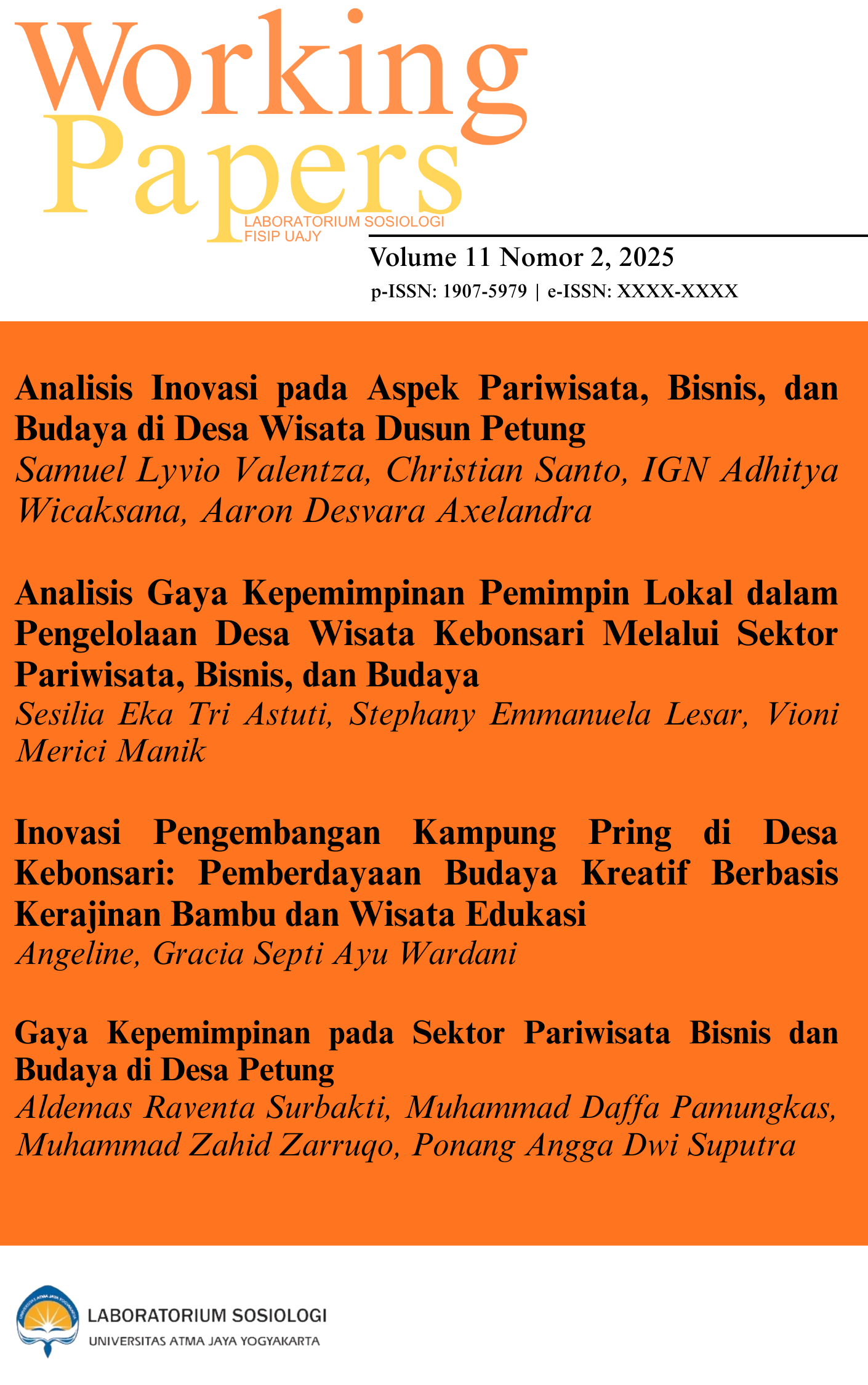
Main Article Content
Abstract
This study focuses on the role of local leadership in the post-disaster recovery process following the 2010 eruption of Mount Merapi in Petung Village, Kepuharjo, Cangkringan District, Sleman, by examining three main sectors: tourism, culture, and local business. This research employs a qualitative exploratory method to understand leadership practices that emerge within a post-disaster community context. The findings indicate that, first, leadership in the tourism sector develops in a charismatic-collective form based on social legitimacy, playing a crucial role in mobilizing solidarity, managing conflict, and encouraging broad community participation in economic activities. Second, in the cultural sector, leadership takes a democratic-facilitative form that emphasizes deliberation, voluntarism, and the preservation of communal values, although it faces challenges due to the shifting economic priorities of the community after the disaster. Third, the business sector demonstrates a situational-adaptive leadership pattern oriented toward business sustainability and its social function as a provider of local employment, yet it remains limited in terms of long-term planning and professionalization. Overall, this study shows that local leadership in Petung Village does not primarily rely on formal structures, but rather on social legitimacy, social capital, and the ability to adapt to post-disaster conditions. The novelty of this research lies in its integrative analysis of three strategic sectors, which reveals local leadership as a spectrum of contextual practices in fostering sustainable post-disaster socio-economic development.