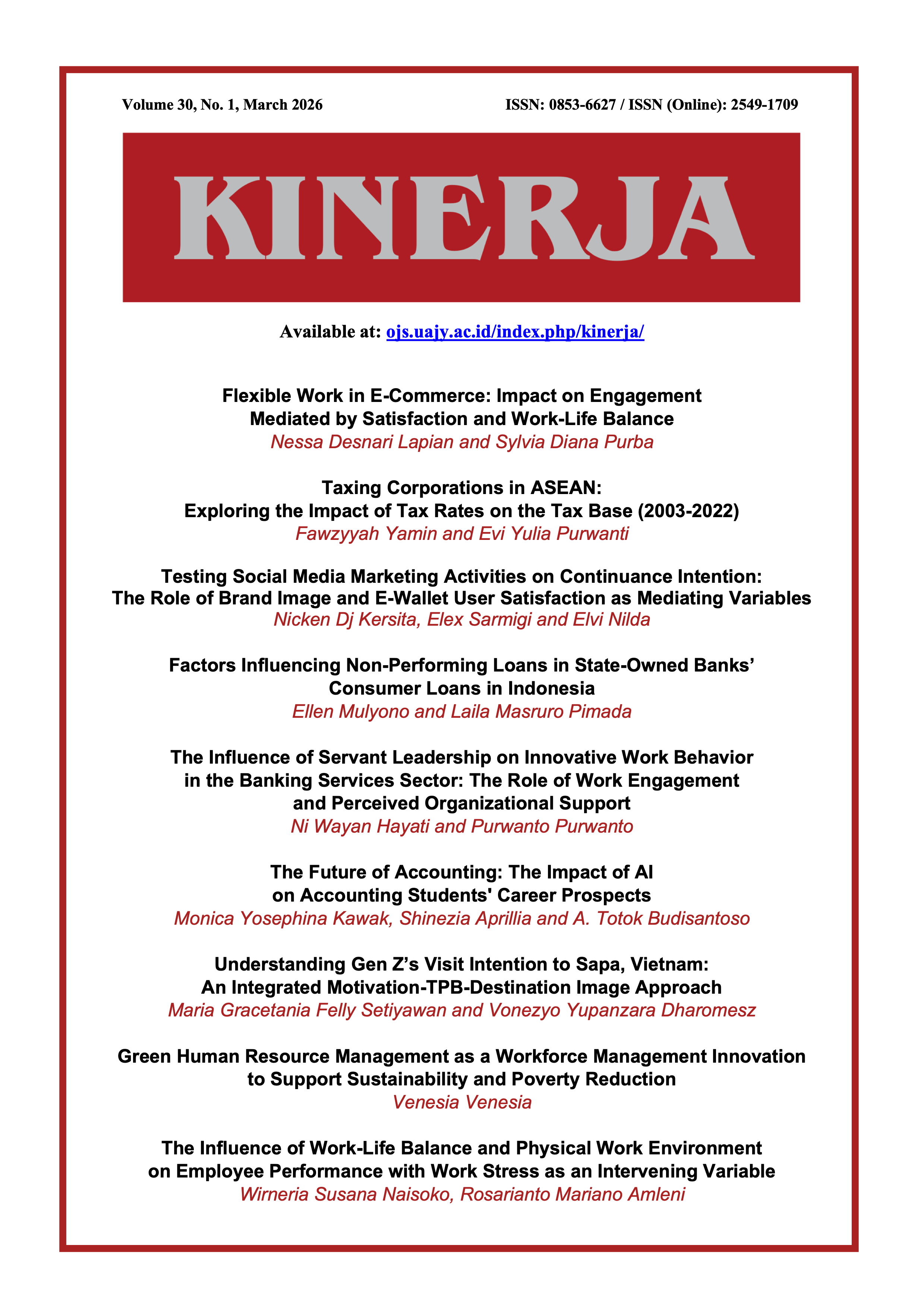
The Influence of Work-Life Balance and Physical Work Environment on Employee Performance with Work Stress as an Intervening Variable
DOI:
https://doi.org/10.24002/kinerja.v30i1.13239Keywords:
work-life balance, physical work environment, work stress, employee performanceAbstract
This study aims to examine the influence of Work-Life Balance and the Physical Work Environment on Employee Performance, with Work Stress as an Intervening Variable, in the Pamong Praja Police Unit of North Central Timor Regency. Using a quantitative approach, a simple random sampling technique was employed to gather data from 83 employees of the North Central Timor Regency Pamong Praja Police Unit. The data analysis techniques used are inner model analysis, outer model analysis, and model fit test. The analysis revealed that both Work-Life Balance and Physical Work Environment positively affect Employee Performance, specifically mediated by levels of Work Stress. The T-test results demonstrated significant statistical evidence (T statistic > T table) for these relationships. It was recommended that organizations take steps to improve the work-life balance and physical work environment to improve the level of employee performance.
References
Afandi, P. (2018). Manajemen sumber daya manusia: Teori, konsep dan indikator (Cet. 1). Zanafa Publishing.
Alam, S. (2020). The role of physical work environment and work stress in affecting employee performance. International Journal of Multicultural and Multireligious Understanding, 7(8), 529–535. https://doi.org/10.18415/ijmmu.v7i8.1962
Alni, R. A. S. (2024). Pengaruh lingkungan kerja dan work-life balance terhadap kepuasan kerja: Stres kerja sebagai variabel intervening. Jurnal Syntax Admiration, 5(11), 4494–4506. https://doi.org/10.46799/jsa.v5i11.1533
Appel-Meulenbroek, R., Groenen, P., & Janssen, I. (2020). Impact of activity-based workplaces on burnout and engagement dimensions. Journal of Corporate Real Estate, 22(4), 279–296. https://doi.org/10.1108/JCRE-09-2019-0041
Arwidiana, D. P., & Citrawati, N. K. (2023). Hubungan stres kerja dengan kinerja pegawai. Jurnal Ilmiah Cakrawarti, 6(1), 122–129. https://doi.org/10.47532/jic.v6i1.809
Ayoko, O. B., & Ashkanasy, N. M. (2020). The physical environment of office work: Future open plan offices. Australian Journal of Management, 45(3), 488–506. https://doi.org/10.1177/0312896220921913
Bakker, A. B., & Demerouti, E. (2017). Job demands-resources theory: Taking stock and looking forward. Journal of Occupational Health Psychology, 22(3), 273–285.
Bakker, A. B., Demerouti, E., & Sanz-Vergel, A. (2023). Job demands–resources theory: Ten years later. Annual review of organizational psychology and organizational behavior, 10(1), 25-53.
Barasa, L. (2023). An empirical study on the influence of internal and external factors on port enterprise employee performance: A case study in Indonesia. Journal of Eta Maritime Science, 11(4), 290–303. https://doi.org/10.4274/JEMS.2023.05657
Brough, P., Timms, C., O’Driscoll, M. P., Siu, O. L., Kalliath, T., Sit, C., Lo, D., & Lu, C. Q. (2020). Work-life balance: Definitions, causes, and consequences. In Handbook of socioeconomic determinants of occupational health. https://doi.org/10.1007/978-3-030-05031-3
Bukit, B., Malusa, T., & Rahmat, A. (2016). Pengembangan sumber daya manusia: Teori, dimensi pengukuran, dan implementasi dalam organisasi. Zahir Publishing.
Chen, B., Wang, L., Li, B., & Liu, W. (2022). Work stress, mental health, and employee performance. Frontiers in psychology, 13, 1006580. https://doi.org/10.3389/fpsyg.2022.1006580
D. S., S. (2024). A conceptual framework for the work-life balance of police officers: A post-COVID-19 perspective. Cogent Business & Management, 11(1), 2304429. https://doi.org/10.1080/23311975.2024.2304429
David, J., Adimasta, B., & Lataruva, E. (2025). Work-life balance: The key to employee engagement and employee performance. Arthatama: Journal of Business Management and Accounting, 9(1), 71–82. https://journal.lifescifi.com/index.php/art/article/view/647
Demerouti, E. (2025). Job demands-resources and conservation of resources theories: How do they help to explain employee well-being and future job design? Journal of Business Research, 192, Article 115296. https://doi.org/10.1016/j.jbusres.2025.115296
Durai, P. (2016). Human resource management. Pearson Education.
Dwitama, F., & Ariyanto, E. (2024). Pengaruh work life balance dan lingkungan kerja non fisik terhadap kinerja pegawai pada Badan Kepegawaian Daerah Provinsi Sumatera Barat yang dimediasi kepuasan. Jurnal Informatika Ekonomi Bisnis, 6(3), 612–617. https://doi.org/10.37034/infeb.v6i3.945
Dwitanti, E., Murwani, F. D., & Siswanto, E. (2023). The effect of work-life balance on employee performance through work stress and workload. International Journal of Business, Law, and Education, 4(2), 569–586. https://doi.org/10.56442/ijble.v4i2.211
Enny, M. (2019). Manajemen sumber daya manusia. UBHARA Manajemen Press. http://eprints.ubhara.ac.id/424/31/Buku-MSDM-2019.pdf
Fajar, T. P., & Luturlean, B. S. (2023). Pengaruh work life balance dan lingkungan kerja non fisik terhadap kinerja karyawan pada PT Kimia Farma Tbk Jakarta. Komitmen: Jurnal Ilmiah Manajemen, 4(2), 137–144. https://doi.org/10.15575/jim.v4i2.28155
Fiernaningsih, et al. (2024). Manajemen sumber daya manusia. PT Literasi Nusantara Abadi Group.
Fitri, N. N., & Ferdian, A. (2021). Pengaruh lingkungan kerja fisik dan lingkungan kerja non fisik terhadap kinerja karyawan pada PT Infrastruktur Telekomunikasi Indonesia. Jurnal Ilmiah Mahasiswa Ekonomi Manajemen, 6(2), 444–455.
Fitriani, D., Nurlaela, N., & Sudarwadi, D. (2019). Lingkungan kerja fisik, lingkungan kerja non fisik, dan disiplin kerja terhadap kinerja pegawai guru SMK Negeri 1 Manokwari. Cakrawala Management Business Journal, 1(1), 119–132. https://doi.org/10.30862/cm-bj.v1i1.8
Galanakis, M. D., & Tsitouri, E. (2022). Positive psychology in the working environment: Job demands-resources theory, work engagement and burnout: A systematic literature review. Frontiers in Psychology, 13, Article 1022102. https://doi.org/10.3389/fpsyg.2022.1022102
Garini, R. A., & Muafi, M. (2023). The effect of digital competence, work life balance and work stress towards service performance with moderation of emotional intelligence on employees of PT X. International Journal of Business Ecosystem & Strategy, 5(2), 1–11. https://doi.org/10.36096/ijbes.v5i2.403
Gragnano, A., Simbula, S., & Miglioretti, M. (2020). Work-life balance: Weighing the importance of work-family and work-health balance.
Hafee, I., et al. (2019). Impact of workplace environment on employee performance: Mediating role of employee health. Business, Management and Education, 17(2), 173–193. https://doi.org/10.3846/bme.2019.10379
Hamali, A. Y. (2016). Pemahaman manajemen sumber daya manusia (Cet. 1). Center for Academic Publishing (CAPS).
Jamillah, K., Setyanti, S. W., & Mufidah, A. (2023). Work life balance, self efficacy, employee engagement dan kinerja pegawai. CV Media Sains Indonesia.
Karim, E. (2025). Work environment and work stress. Jurnal Akuntansi, Manajemen dan Ilmu Ekonomi (JASMIEN), 5, 1–8. https://doi.org/10.54209/jasmien.v5i03.1249
Kartika, P. D., & Riana, I. G. (2024). Peran work-life balance dalam memediasi pengaruh beban kerja terhadap stres kerja karyawan. Journal of Business, Finance, and Economics, 5(1), 131–142. https://doi.org/10.32585/jbfe.v5i1.5116
Khaeruman, et al. (2021). Meningkatkan kinerja sumber daya manusia: Konsep & studi kasus. CV. A. A. Rizky.
Khateeb Károly, F. R. (2021). Work life balance: A review of theories, definitions and policies. Cross-Cultural Management Journal, 23(1), 27–55.
Kurniaty, H. (2020). Pengaruh stres lingkungan kerja, stres kerja organisasi dan stres kerja pribadi terhadap kinerja pegawai pada Dinas Kependudukan dan Pencatatan Sipil Kabupaten Barito Selatan. Restorica: Jurnal Ilmiah Ilmu Administrasi Negara dan Ilmu Komunikasi, 6(2), 70–81. https://doi.org/10.33084/restorica.v6i2.1780
Leka, S. (2003). Work organisation and stress. World Health Organization. http://www.who.int/occupational_health/publications/en/oehstress.pdf
Lesener, T., Gusy, B., & Wolter, C. (2019). The job demands-resources model: A meta-analytic review of longitudinal studies. Work & Stress, 33(1), 76–103. https://doi.org/10.1080/02678373.2018.1529065
Mangkunegara, A. P. (2014). Evaluasi kinerja SDM (Cet. 7). PT Refika Aditama.
Mangkunegara, A. P. (2019). Perencanaan dan pengembangan sumber daya manusia (Cet. 8). Refika Aditama.
Mardiani, I. N., & Widiyanto, A. (2021). Pengaruh work-life balance, lingkungan kerja, dan kompensasi terhadap kinerja karyawan PT Gunanusa Eramandiri. Jesya: Jurnal Ekonomi & Ekonomi Syariah, 4(2), 985–993. https://doi.org/10.36778/jesya.v4i2.456
Mardiyana, M., & Hidayat, R. (2024). Pengaruh work life balance dan lingkungan kerja non fisik terhadap kinerja karyawan dengan kepuasan kerja sebagai variabel intervening pada PT Yamaha Music Manufacturing Indonesia (studi kasus departemen produksi). Scientific Journal of Reflection: Economic, Accounting, Management and Business, 7(4), 1436–1450. https://doi.org/10.37481/sjr.v7i4.1021
Marecki, Ł. (2024). Impact of work-life balance on employee productivity and well-being. Journal of Management and Financial Sciences, 16(50), 165–178. https://doi.org/10.33119/JMFS.2023.50.9
Mubarak, A. (2023). Apakah work-life balance masih layak diteliti? Systematic review mengenai work life balance terkini. Schema: Journal of Psychological Research, 8(2), 68-81.
Nasrul, R. N., Zainal, V. R., & Hakim, A. (2023). Workload, work stress, and employee performance: A literature review. Dinasti International Journal of Education Management and Social Science, 4(3), 415–422.
Ningsih, T. S., & Hermiati, N. F. (2023). Pengaruh work life balance dan lingkungan kerja non fisik terhadap kinerja karyawan dengan kepuasan kerja sebagai variabel intervening (studi kasus distributor Marwah Skincare Cilacap). JEMSI (Jurnal Ekonomi, Manajemen, dan Akuntansi), 9(3), 611–621. https://doi.org/10.35870/jemsi.v9i3.1094
Noya, J. (2024). Physical and non-physical work environment on employee performance. Asian Journal of Management, Entrepreneurship and Social Science, 4(2), 908–921.
Nurdin, P. B. R., Munizu, M., & Sumardi. (2021). Employee performance: Worklife balance to maintain organizational commitment and work motivation. YUME: Journal of Management, 4(2), 182–194. https://doi.org/10.37531/yume.vxix.861
Ogunola, A. A. (2022). Quality of work-life and work-life balance as predictors of employee job satisfaction. Tazkiya: Journal of Psychology, 10(1), 74–84. https://doi.org/10.15408/tazkiya.v10i1.22499
Oktafien, S., Santoso, A. B., & Azali, M. (2021). The effect of work life balance on improving employee performance. Turkish Journal of Computer and Mathematics Education, 12(11), 1321–1326. https://www.proquest.com/scholarly-journals/effect-work-life-balance-on-improving-employee/docview/2623918262/se-2
Oyedeji, B. A., Ko, Y. H., & Lee, S. (2025). Physical work environments: An integrative review and agenda for future research. Journal of Management, 51(6), 2589–2626. https://doi.org/10.1177/01492063251315703
Pradoto, H., Haryono, S., & Wahyuningsih, S. H. (2022). The role of work stress, organizational climate, and improving employee performance in the implementation of work from home. Work, 71(2), 345–355. https://doi.org/10.3233/WOR-210678
Purwanti, S. S. H. (2024). The effect of organizational justice on the quality of work life through organizational commitment as a mediating variabel. Mantik Journal, 7(4), 2789-2887. https://iocscience.org/ejournal/index.php/mantik/article/view/4570/3187
Purwanto, F., & Pratiwi, E. C. (2024). The influence of work-life balance and work environment on employee productivity through job stress. ASSETS: Jurnal Ekonomi, Manajemen & Akuntansi, 14(2), 231–246. https://doi.org/10.24252/assets.v14i2.51211
Rivalita, C., & Ferdian, A. (2020). Pengaruh lingkungan kerja fisik dan lingkungan kerja non fisik terhadap kinerja pegawai outsource cleaning service di Universitas Telkom. Jurnal Mitra Manajemen, 4(4), 509–522. https://doi.org/10.52160/ejmm.v4i4.361
Robbins, S. P. (2008). Perilaku organisasi (D. Angelica, R. Cahyani, & A. Rosyid, Trans.).
Robbins, S. P., & Judge, T. A. (2017). Perilaku organisasi (A. Suslia, Ed.; Edisi 16). Salemba Empat.
Robbins, S. P., & Judge, T. A. (2024). Organizational behavior (19th ed.). Pearson.
Saputra, A. F., & Masdupi, E. (2024). Work-life balance di dunia kerja (1st ed.). PACE. https://digitalpress.gaes-edu.com/index.php/gaespace/issue/download/63/3
Septria, D., et al. (2022). Effect of physical work environment and work motivation on the performance of civil servants in South Sumatra Province Forestry Service. International Journal of Social Sciences, 5(4), 334–340. https://doi.org/10.21744/ijss.v5n4.2044
Setyawan, C. A., Nurhidayah, N., & Bastomi, M. (2023). The influence of work life balance, quality work life and work engagement on employee performance. Jurnal Riset Manajemen, 12(2), 1–8. https://jim.unisma.ac.id/index.php/jrm/article/view/20446
Shaari, R., Sarip, A., & Ramadhinda, S. (2022). A study of the influence of physical work environments on employee performance. International Journal of Academic Research in Business and Social Sciences, 12(12), 1734–1742. https://doi.org/10.6007/IJARBSS/v12-i12/15975
Shammout, M. (2021). The impact of work environment on employees performance.
Shetu, S. H., et al. (2025). From stress to exit: Can work-life balance pull employees back? A JD-R perspective. Journal of Human Resource and Sustainability Studies, 13(4), 665–686. https://doi.org/10.4236/jhrss.2025.134032
Sinkey, M. S. (2024). Effects of job stress on employee performance level in the health sector of South Africa. European Journal of Business and Innovation Research, 12(3), 16–26. https://doi.org/10.37745/ejbir.2013/vol12n31626
Subarno, A., Indrawati, C. D. S., & Ninghardjanti, P. (2025). The influence of physical and non-physical factors on employee well-being in office spaces: A comprehensive study of the work environment. IOP Conference Series: Earth and Environmental Science, 1462(1), Article 012023. https://doi.org/10.1088/1755-1315/1462/1/012023
Suhartini, S. (2021). Pengaruh work life balance dan lingkungan kerja non fisik terhadap kinerja karyawan di PT Polychem Indonesia Tbk. (Divisi Mesin). eCo-Buss, 3(3), 122–131. https://doi.org/10.32877/eb.v3i3.207
Syahada, L. E., & Firdaus, R. (2025). The effect of work-life balance, work stress, and workload on employee performance with organizational support as moderation variable. Daengku: Journal of Humanities and Social Sciences Innovation, 5(2), 264–276. https://doi.org/10.35877/454RI.daengku3813
Tirta, T. (2023). Dampak lingkungan kerja terhadap kinerja pegawai dimediasi motivasi kerja di Dinas Pekerjaan Umum dan Penataan Ruang Kabupaten Tanjung Jabung Barat. Jurnal Manajemen Terapan dan Keuangan, 12(2), 494–506.
Wahyuni, L., Sidik, M. J., & Dwiyanti, R. (2020). The effect of work environment on work stress in production employees PT Philnesia Semarang. In Future psychology: Interaction of human behavior, culture, and technology to create Society 5.0 (pp. 152–159).
Yi, T., & Mei Peng, L. (2023). Do gig workers enjoy work-life balance? Exploring the influencing factors for work-life balance among the gig workers. Conference on Management, Business, Innovation, Education and Social Science, 3(1), 100–110.
Van Zyl, L. E., et al. (2025). Cracks in the JD-R model? The failure of strengths use, job crafting, and home-work spillover to support wellbeing during COVID-19. Frontiers in Psychology, 16. https://doi.org/10.3389/fpsyg.2025.1532083
Downloads
Published
Issue
Section
License
Copyright (c) 2026 Wirneria Susana Naisoko, Rosarianto Mariano Amleni

This work is licensed under a Creative Commons Attribution 4.0 International License.