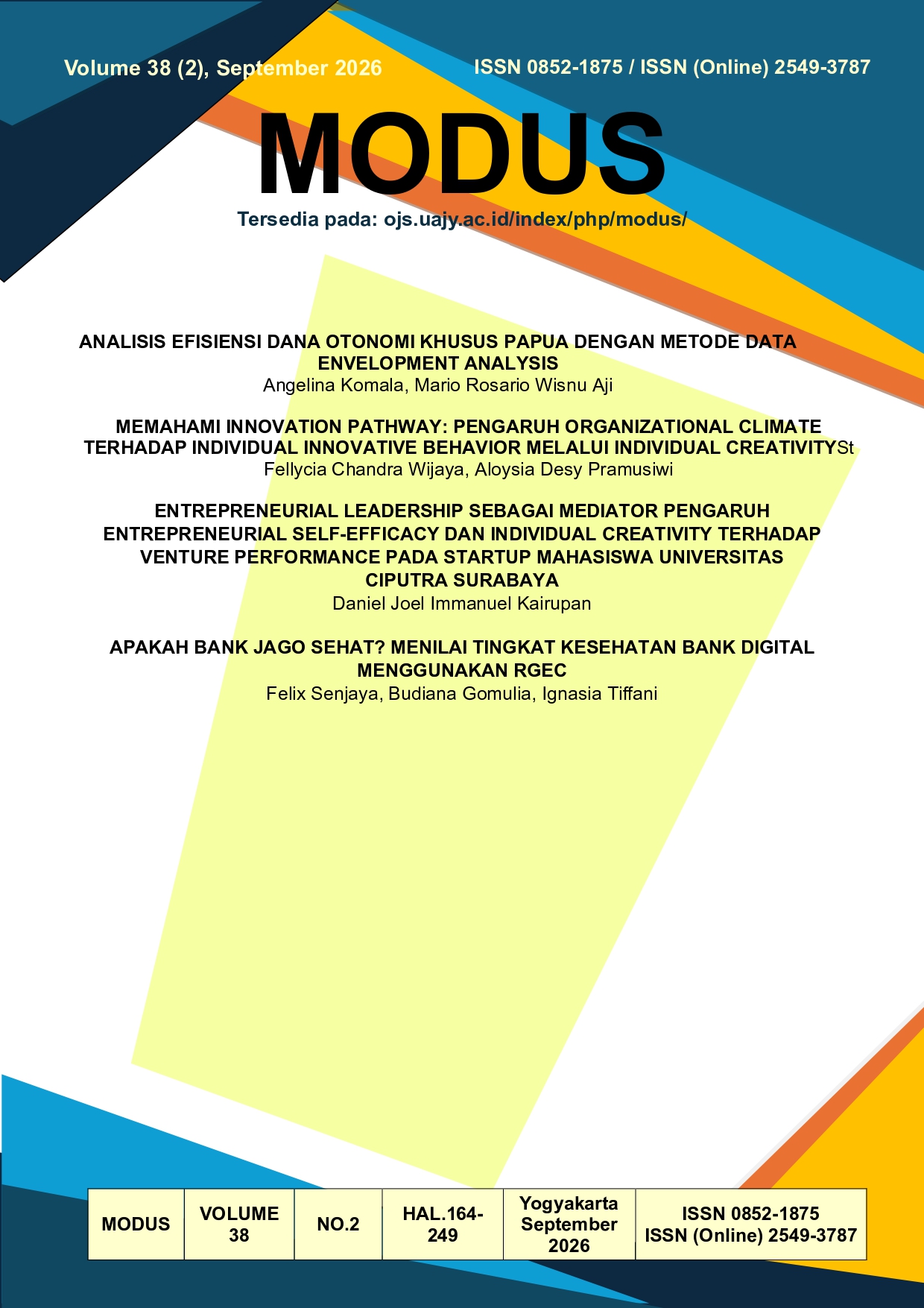
Memahami Innovation Pathway: Pengaruh Organizational Climate terhadap Individual Innovative Behavior melalui Individual Creativity
DOI:
https://doi.org/10.24002/modus.v38i2.15567Abstract
In today’s competitive business, innovative behavior and individual creativity are key factors in enhancing an organization’s success. Therefore, innovation is one of the areas that organizations need to manage effectively. This study aims to explore the influence of organizational climate on individual innovative behavior, with individual creativity serving as a mediating variable. The research focused on employees of PT Delta Merlin Sandang Tekstil located in Surakarta. Out of a total of 123 respondents who participated, only 119 data sets were deemed valid and met the criteria for analysis. A non-probability sampling technique was employed, specifically using purposive sampling, while data collection was conducted online via the Google Forms platform. A quantitative approach was adopted in this study, with data analyzed using Structural Equation Modeling–Partial Least Squares (SEM-PLS) through the SmartPLS 3.0 software. The analysis results indicate that both organizational climate and individual creativity have a significant and positive effect on individual innovative behavior. Furthermore, individual creativity was found to mediate the relationship between organizational climate and individual innovative behavior.
Keywords: organizational climate; individual innovative behavior; individual creativity; innovative.
Di dunia bisnis yang kompetitif saat ini, perilaku inovatif dan kreativitas individu menjadi faktor kunci untuk meningkatkan kesuksesan suatu organisasi. Dengan demikian, inovasi menjadi salah satu hal yang perlu dikelola dengan maksimal oleh organisasi. Penelitian ini bertujuan untuk mengeksplorasi pengaruh organizational climate terhadap individual innovative behavior dengan mediasi dari individual creativity. Fokus penelitian ini adalah karyawan PT Delta Merlin Sandang Tekstil yang berlokasi di Surakarta. Dari total 123 responden yang berpartisipasi, hanya 119 data yang dinyatakan valid dan memenuhi kriteria analisis. Teknik pengambilan sampel yang digunakan adalah non-probability sampling dengan pendekatan purposive sampling, sementara proses pengumpulan data dilakukan secara daring melalui platform Google Forms. Pendekatan kuantitatif digunakan dalam penelitian ini dengan metode analisis Structural Equation Modeling-Partial Least Squares (SEM-PLS) menggunakan perangkat lunak SmartPLS 3.0. Hasil analisis menunjukkan bahwa organizational climate dan individual creativity memiliki pengaruh yang signifikan dan positif terhadap individual innovative behavior. Selain itu, individual creativity terbukti memediasi hubungan antara organizational climate dan individual innovative behavior.
Kata kunci: organizational climate; individual innovative behavior; individual creativity; innovative.
References
Ahmad, R., Nawaz, M. R., Ishaq, M. I., Khan, M. M., & Ashraf, H. A. (2023). Social exchange theory: Systematic review and future directions. Frontiers in Psychology, 13. https://doi.org/10.3389/fpsyg.2022.1015921
Alagele, H. K. H., Neama, N. H., Alkaseer, N. ahmed, Al Dulaimi, H. A., & Abd, S. E. (2025). The Mediating Role of Artificial Intelligence on the Relationship between Organizational Climate and Employee Creativity Behavior: A Field Study. Journal of Ecohumanism, 4(2). https://doi.org/10.62754/joe.v4i2.5736
Asbari, M., Budi Prasetya, A., Santoso, P. B., & Purwanto, A. (2021). From Creativity to Innovation: The Role of Female Employees’ Psychological Capital. http://www.ijosmas.org
Asif, S., & Shahbaz, M. S. (2025). Project Success through Organizational Climate and Work Behavior: Systematic Literature Review. Journal of Organizational Behavior Research, 10(1), 1–14. https://doi.org/10.51847/cUhkprt6DJ
Bagheri, A., Akbari, M., & Artang, A. (2022). How does entrepreneurial leadership affect innovation work behavior? The mediating role of individual and team creativity self-efficacy. European Journal of Innovation Management, 25(1), 1–18. https://doi.org/10.1108/EJIM-07-2020-0281
Blau, P. M. (1986). Justice in Social Exchange.
Cai, W., Khapova, S., Bossink, B., Lysova, E., & Yuan, J. (2020). Optimizing employee creativity in the digital era: Uncovering the interactional effects of abilities, motivations, and opportunities. International Journal of Environmental Research and Public Health, 17(3). https://doi.org/10.3390/ijerph17031038
Cheung, C. M., Zhang, R. P., Wang, R., Hsu, S.-C., & Manu, P. (2022). Group-Level Safety Climate in the Construction Industry: Influence of Organizational, Group, and Individual Factors. Journal of Management in Engineering, 38(1), 4021080. https://doi.org/10.1061/(ASCE)ME.1943-5479.0000978
De Jong, J., & Den Hartog, D. (2010). Measuring innovative work behaviour. Creativity and Innovation Management, 19(1), 23–36. https://doi.org/10.1111/j.1467-8691.2010.00547.x
Dong, R. K., Li, X., & Hernan, “Banjo” Roxas. (2024). Psychological safety and psychosocial safety climate in workplace: A bibliometric analysis and systematic review towards a research agenda. Journal of Safety Research, 91, 1–19. https://doi.org/10.1016/j.jsr.2024.08.001
Dongxian, L., & Batool, H. (2024). Influence of distributed leadership on employee innovative behaviour: the mediating role of psychological empowerment. Journal of Innovation and Entrepreneurship, 13(1). https://doi.org/10.1186/s13731-024-00448-7
Duan, W., Tang, X., Li, Y., Cheng, X., & Zhang, H. (2020). Perceived Organizational Support and Employee Creativity: The Mediation Role of Calling. Creativity Research Journal, 32(4), 403–411. https://doi.org/10.1080/10400419.2020.1821563
Fadila, F., & Sawitri, H. S. R. (2023). A Conceptual Model: The Mediating Role of Creativity Climate in Empowering Leadership on Management Innovation and Innovative Behavior. European Journal of Business and Management Research, 8(3), 316–319. https://doi.org/10.24018/ejbmr.2023.8.3.1989
Global Innovation Index 2024. (2024). World Intellectual Property Organization.
Gong, Y. (2010). Employee learning orientation, transformational leadership, and employee creativity: The mediating role of employee creative self-efficacy. Development and Learning in Organizations: An International Journal, 24(2), 366–372. https://doi.org/10.1108/dlo.2010.08124bad.003
Hadi, S., Putra, A. R., & Mardikaningsih, R. (2020). Pengaruh Perilaku Inovatif dan Keterlibatan Kerja terhadap Kinerja Karyawan. Jurnal Baruna Horizon, 3(1).
Hadouga, H. (2024). The relationship between organizational climate and organizational commitment in light of the employee empowerment behaviour variable during the COVID-19 pandemic: A case study of the general hospital of Kettar Algeria. Ekonomicko-Manazerske Spektrum, 18(1), 67–78. https://doi.org/10.26552/ems.2024.1.67-78
Hair, J. F. , Hult, G. T. M. , Ringle, C. M. , Sarstedt, M. , Danks, N. P. , & Ray, S. (2021). Classroom Companion: Business Partial Least Squares Structural Equation Modeling (PLS-SEM) Using R AAWorkbook.
Ijaz, S. (2022). Impact of Organizational Support on Employee Creativity and Innovative Work Behavior: Mediation of Employee Creativity. Pakistan Social Sciences Review, 6(4). https://doi.org/10.35484/pssr.2022(6-iv)05
Janssen, O. (2000). Job demands, perceptions of effort-reward fairness and innovative work behaviour. Journal of Occupational and Organizational Psychology, 73(3), 287–302. https://doi.org/10.1348/096317900167038
Joo, B. K. Brian, McLean, G. N., & Yang, B. (2013). Creativity and Human Resource Development: An Integrative Literature Review and a Conceptual Framework for Future Research. Human Resource Development Review, 12(4), 390–421. https://doi.org/10.1177/1534484313481462
Juliana, N. O., Hui, H. J., Clement, M., Solomon, E. N., & Elvis, O. K. (2021). The Impact of Creativity and Innovation on Entrepreneurship Development: Evidence from Nigeria. Open Journal of Business and Management, 09(04), 1743–1770. https://doi.org/10.4236/ojbm.2021.94095
Lambriex-Schmitz, P., Van der Klink, M. R., Beausaert, S., Bijker, M., & Segers, M. (2020). Towards successful innovations in education: Development and validation of a multi-dimensional Innovative Work Behaviour Instrument. Vocations and Learning, 13(2), 313–340. https://doi.org/10.1007/s12186-020-09242-4
Mogård, E. V., Rørstad, O. B., & Bang, H. (2023). The Relationship between Psychological Safety and Management Team Effectiveness: The Mediating Role of Behavioral Integration. International Journal of Environmental Research and Public Health, 20(1). https://doi.org/10.3390/ijerph20010406
Moser, T., Seibt, T., & Neuert, J. (2021). Organizational Culture and Organizational Climate Research: A Systematic Literature Review.
Mutonyi, B. R., Slåtten, T., & Lien, G. (2020a). Empowering leadership, work group cohesiveness, individual learning orientation and individual innovative behaviour in the public sector: empirical evidence from Norway. International Journal of Public Leadership, 16(2), 175–197. https://doi.org/10.1108/IJPL-07-2019-0045
Mutonyi, B. R., Slåtten, T., & Lien, G. (2020b). Organizational climate and creative performance in the public sector. European Business Review, 32(4), 615–631. https://doi.org/10.1108/EBR-02-2019-0021
Oktavia, Dzakirah, N. A., Defana, M. A. B., & Noviyanti, I. (2024). Beradaptasi dengan Perubahan Pasar dalam Strategi Bersaing yang Fleksibel dan Dinamis. Jurnal Manajemen Sosial Ekonomi (DINAMIKA), 4(2).
Rahmat, A., Abdillah, M. R., Priadana, M. S., Wu, W., & Usman, B. (2020). Organizational Climate and Performance: The Mediation Roles of Cohesiveness and Organizational Commitment. IOP Conference Series: Earth and Environmental Science, 469(1). https://doi.org/10.1088/1755-1315/469/1/012048
Salsabila, Z. H., & Mansyur, A. (2024). Innovative work behavior: Role of organizational climate and employee creativity. Jurnal Fokus Manajemen Bisnis, 14(1), 71–83. https://doi.org/10.12928/fokus.v14i1.9491
Scott, S. G., & Bruce, R. A. (1994). Determinants of Innovative Behavior: A Path Model of Individual Innovation in the Workplace. Source: The Academy of Management Journal, 37(3).
Sekaran, U., & Bougie, R. (2019). Research Methods for Business: A Skill Building Approach. https://books.google.co.id/books/about/Research_Methods_For_Business.html?hl=id&id=ikI6EAAAQBAJ&redir_esc=y
Volery, T., & Tarabashkina, L. (2021). The impact of organisational support, employee creativity and work centrality on innovative work behaviour. Journal of Business Research, 129, 295–303. https://doi.org/10.1016/j.jbusres.2021.02.049
Yin, W., & Liu, S. (2022). The relationship between empowering leadership and radical creativity. Frontiers in Psychology, 13. https://doi.org/10.3389/fpsyg.2022.1002356
You, Y., Hu, Z., Li, J., Wang, Y., & Xu, M. (2022). The Effect of Organizational Innovation Climate on Employee Innovative Behavior: The Role of Psychological Ownership and Task Interdependence. Frontiers in Psychology, 13. https://doi.org/10.3389/fpsyg.2022.856407
Zhao, X., Lynch, J. G., & Chen, Q. (2010). Reconsidering Baron and Kenny: Myths and truths about mediation analysis. Journal of Consumer Research, 37(2), 197–206. https://doi.org/10.1086/651257
Zhou, J., & George, J. M. (2001). When Job Dissatisfaction Leads to Creativity: Encouraging the Expression of Voice. The Academy of Management Journal, 44(4), 682–696. https://doi.org/10.2307/3069410
Downloads
Published
Issue
Section
License
Copyright (c) 2026 Aloysia Desy Pramusiwi, Fellycia Chandra Wijaya

This work is licensed under a Creative Commons Attribution-ShareAlike 4.0 International License.